
Advent really is a wonderful time of the year. While we are bombarded with all manner of advertisements for gifts that we need to buy (targeted at us with eerie precision) and inundated with last minute requests to complete a wide variety of tasks before the year’s end, we’re reminded by the Church that ‘the King, the Lord of the earth is coming. He will take the burden of captivity from our shoulders’ (Magnificat antiphon for Monday, week 2 of Advent).
It is easy for us to miss the significance of such statements which the Church continues to proclaim because, like those to whom Jesus addressed the invitation to be his true disciples in John 8, we don’t even recognise our slavery: “We have never been in bondage to any one. How is it that you say, ‘You will be made free’?” (Jn 8:33).
In his masterful and happily slim little book 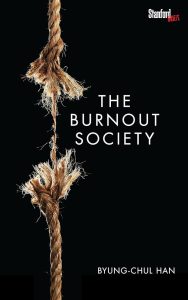 The Burnout Society, philosopher Byung Chul Han pronounces a uniquely insightful diagnosis concerning the cultural malady which confronts us all. Han argues that Foucault’s description of the disciplinary society no is longer an adequate description for our present context, and that our present mode of operation is better characterised as an ‘achievement society’. According to Han, the inhabitants of our new achievement society, ‘are no longer “obedience-subjects” but “achievement-subjects.” They are entrepreneurs of themselves’, (8).
The achievement society is characterised by a pure positivity which seemingly is indicative of a common freedom from the coercive strictures of the disciplinary society. In the achievement society, the operative verb is Can, rather than Should. Han explains: ‘Unlimited Can is the positive modal verb of achievement society. Its plural form—the affirmation, “Yes, we can”—epitomises achievement society’s positive orientation. Prohibitions, commandments, and the law [which characterise the disciplinary society] are replaced by projects, initiatives, and motivation’ (9).
For Han, such positivity masks a kind of paradoxical self-enslavement which is the common experience of the achievement subject. Whilst seeming to operate as an ultimate liberation, the lack of limitation applied to the Can of the achievement society effects a slavery upon the inhabitant of the achievement society that is continuous with that experienced by the inhabitant of the disciplinary society. Han will demonstrate with uncanny precision that the kind of hyperactivity that has come to be paradigmatic of contemporary achievement culture, which is a result of the ubiquitous disposition of Can, is in fact more pernicious than the mechanisms of force and coercive power that dominate in a disciplinary society: ‘The positivity of Can is much more efficient than the negativity of Should’ (9).
Lest we begin to think that this situation is more desirable, Han explains the dynamics of the paradoxical slavery prevalent within achievement society. While ‘the achievement-subject stands free from any external instance of domination forcing it to work, much less exploiting it’, such a ‘disappearance of domination does not entail freedom’ (10).
Han paints a horrifyingly accurate portrayal of the situation of the inhabitant of the achievement society:
“the achievement-subject gives itself over to compulsive freedom—that is, to the free constraint of maximizing achievement. Excess work and performance escalate into auto-exploitation [that is the exploitation of the self by the self]. This is more efficient than allo-exploitation [the exploitation of the self by another], for the feeling of freedom attends it. The exploiter is simultaneously the exploited. Perpetrator and victim can no longer be distinguished. Such self-referentiality produces a paradoxical freedom that abruptly switches over into violence because of the compulsive structures dwelling within it. The psychic indispositions of achievement society [what Han names as depression, ADHD, and burnout syndrome] are pathological manifestations of such a paradoxical freedom’ (10).
The self-enslaving work ethic of the achievement society, as described by Han, bears a striking resemblance to the Pelagian heresy of the 5th century. What was condemned as Pelagianism was a view which saw the perfection to which all are called (Mt 5:48) as something which is achievable via human effort alone. In such a system, Christian faith is reduced to a moralism and the figure of Jesus is understood not as Immanuel, God-with-us, not as a saviour and a redeemer, but as a sage or as a guide to good and holy living. He gives the example and the life advice, and we do the work and achieve our own perfection, pulling ourselves up by our Birkenstock straps.
What Han’s critique reveals is the utter impotence of our efforts to achieve. Achievement, we come to see, has no soteriological function in and of itself, and the effort to which we compel ourselves to achieve our own liberation only serves to enmesh us deeper into the increasingly totalising slavery of auto-compulsion, or auto-exploitation. All this paints a pretty bleak picture—one which we might be tempted to despair at as we realise that our subjection to the hyperactivity of our age is yet another form of slavery that we have subjected ourselves to. And yet, during this season the Church continues to remind us that ‘the King, the Lord of the earth is coming.’ And that ‘He will take the burden of captivity from our shoulders.’ This is good news indeed.
The King who is to come is He who in fact has already come among us. He did not come as a result of human striving or of human achievement, but as an utterly free and gratuitous gift of God. Not only this, He came among us as a helpless, and indeed ‘useless’ child, born of a woman. This fact, the fact of God-made-man in the womb of the virgin—the fact of Mary Theotokos—is precisely what saves us from the pelagian temptation to which we are subject, particularly in this achievement society within which we live, and move, and have our being. Jesus, this little baby born in the stable of Bethlehem some 2000 years ago is, and always was, truly God. In Christ, God enters into our nothingness and takes the burden of captivity from our shoulders. He who is nothing but the love of the Father, shows us not how we are to live, but what we truly are. This season of expectant awaiting liberates us from the auto-compulsion to achieve, and to, like Mary open ourselves to receive the presence of God in Jesus Christ and to bear it out to the world.