The following is a lightly edited extract from this paper, published in the International Studies in Catholic Education. The full citation can be found at the bottom of this article.
In chapter 53 of his widely influential Rule, St Benedict of Nursia (d. AD 547) the so-called founder of Western monasticism instructs his monks to welcome all guests who present themselves to the monastery as if they were welcoming Christ himself, ‘for he himself will say: I was a stranger and you welcomed me (Matt 25:35)’[1] . While written specifically for the regulation of monastic life, Benedict’s Rule bears wisdom that may well be useful in many facets of modern life, whether that be as stakeholders in Catholic schools or other Catholic institutions, or as we consider the state of our Australian nation.
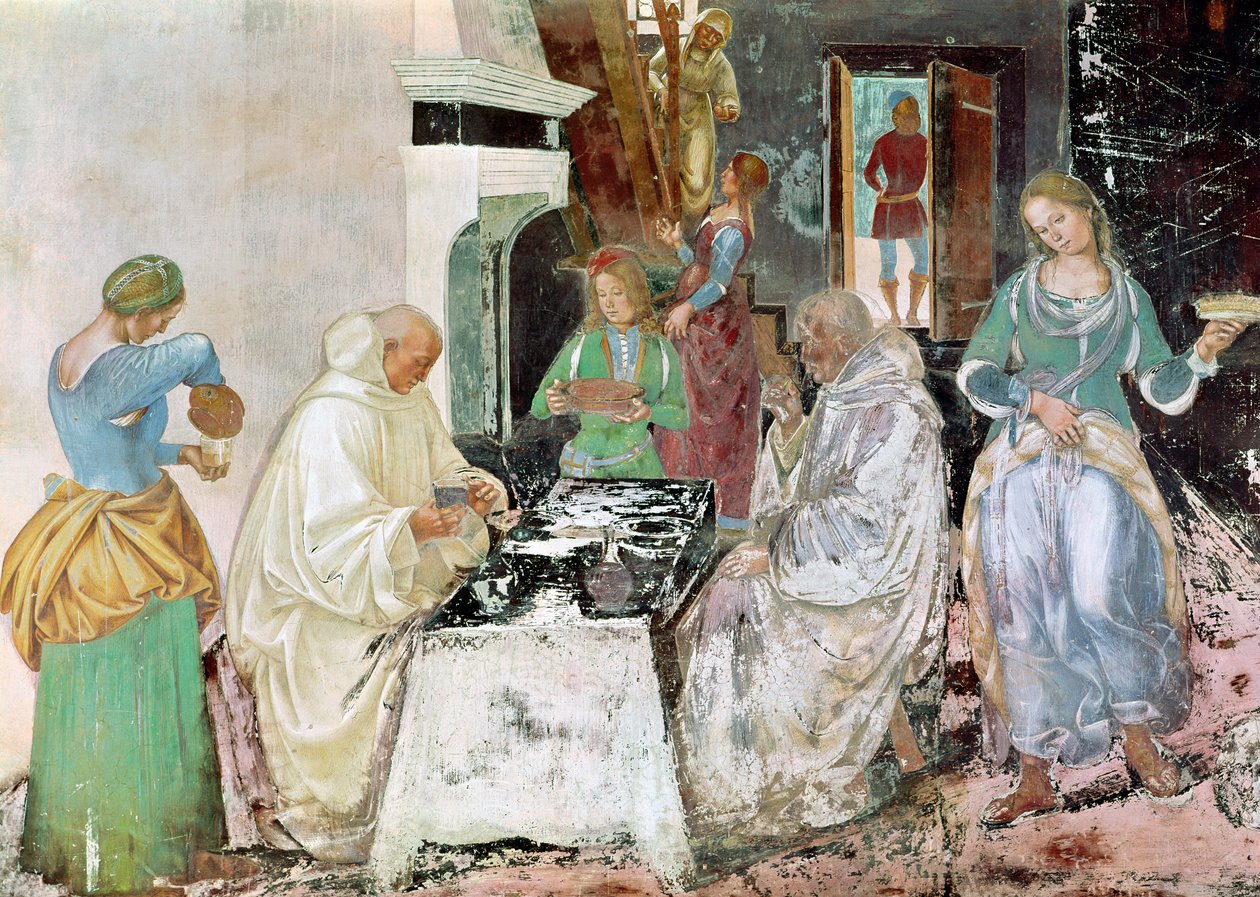
As it pertains to hospitality, Benedict notes that upon greeting the guest, all should be invited to pray, ‘and thus be united in peace’.[2] In the Catholic-Christian tradition prayer itself presumes a common life, both within the community—as is indicated by the opening words to the prayer that Jesus taught his disciples—but also within the Triune Godhead to whom one prays. The ‘being united in peace’ is thus the effect of prayer. Following the prayer, the superior or a brother appointed to the task will sit with the guests, a personal encounter, and read to them the divine law ‘for their instruction’, after which every kindness is to be shown to them.[3]
The posture of hospitality, which has shaped even the architecture of Benedictine monasteries, as well as the specific acts of hospitality exhibited both by monks and by members of the faithful are of course not in themselves understood to be mere contrivance, motivated by a desire to insnare unwitting people in need for the purposes of religious indoctrination. The personalised gesture of welcome, of sitting with the guests that Benedict speaks of denotes both a sense surety in one’s own identity, and an openness to the other as both other and as one bearing an inalienable dignity—who is worthy of receiving the instruction of the Scriptures.
Hospitality requires a recognition of the gift character of what is given both in the other and in oneself, and a willingness to receive. In the encounter between persons one recognises the givenness of oneself, including a recognition of one’s own contingency, which is why Alasdair MacIntyre speaks of hospitality as a practice that emerges from what he calls the ‘virtues of acknowledged dependence’.[4] In this, one also recognises the gift that is the other. Scott H. Moore writes, ‘Hospitality is always particular; it is an offer made to the stranger or the one in need. We can never offer generic hospitality; we always offer hospitality to someone.’[5]
In contrast to the liberal virtues of toleration and inclusivity, the Christian virtue of hospitality ‘is an affirmative rather than a negative practice. There is no hint or connotation of indifference. Rather, hospitality is the abrogation of indifference.’[6] Hospitality, surpassing simple inclusion or tolerance is an active invitation to common life that constantly transforms every person in the community, including those who are involved in offering said hospitality. Rather than negating or relativising difference, hospitality recognises and affirms it and it is precisely in this regard that our differences are saved and a genuine plurality becomes possible. Real relationship and community can only be the result of a union of differences, a genuine plurality. Recognising the distinctiveness of particular cultures does not imply hostility or judgement of others, but rather becomes the precise point wherein one can open up to another. As the philosopher D. C. Schindler argues, ‘Because I love my culture, I can affirm you in a manner that essentially includes your love for your culture, and the very love of my culture, insofar as it is Christian, deepens my affirmation of yours.’[7] Such an affirmation which lies at the heart of genuine hospitality is the sure ground for true dialogue, which Pope Francis reminds us requires a genuine sense of identity.
Finally, in the act of hospitality human communities can be said to image in a particular way to image the communion of the Trinity, the three in one, who exists as pure communion—in a mutual and perfect act of gift and receptivity. And it is precisely in communion that we image most perfectly the Creator God.[8] Thus Catholic schools, exhibiting this virtue of hospitality—despite the ever greater dissimilarity—bear an image of the eternal communion of the Trinity in the societies where they exist.
________
[1] Benedict, RB 1980: The rule of St. Benedict in Latin and English with notes, trans. Timothy Fry (Collegeville, Minn: Liturgical Press, 1981), 53.
[2] Benedict, RB 1980: The rule of St. Benedict in Latin and English with notes, 54 and 58.
[3] Benedict, RB 1980: The rule of St. Benedict in Latin and English with notes, 59.
[4] Alasdair MacIntyre, Dependent Rational Animals: Why Human Beings Need the Virtues (Open Court, 1999), 119-28.
[5] Scott H. Moore, “Hospitality as an Alternative to Tolerance,” Communio (Spokane, Wash.) 27, no. 3 (2000): 603.
[6] Moore, “Hospitality as an Alternative to Tolerance,” 603.
[7] D. C. Schindler, “Restoring Faith in Culture,” Communio: International Catholic Review 48, no. 2, Summer (2021): 241-42.
[8] It is precisely this insight, specifically applied to the sacrament of marriage, but analogically applied to all human communities which forms the basis of Pope St John Paul II’s theology of the body. See John Paul II, Man and Woman He Created Them: A Theology of the Body, trans. Michael Waldstein (Boston, MA: Pauline Books & Media, 2006), 163.
Gourlay, Thomas V. 2025. “Catholic Education, Institutional Identity, and the Reality of Cultural Pluralism.” International Studies in Catholic Education, June, 1–10. doi:10.1080/19422539.2025.2518073