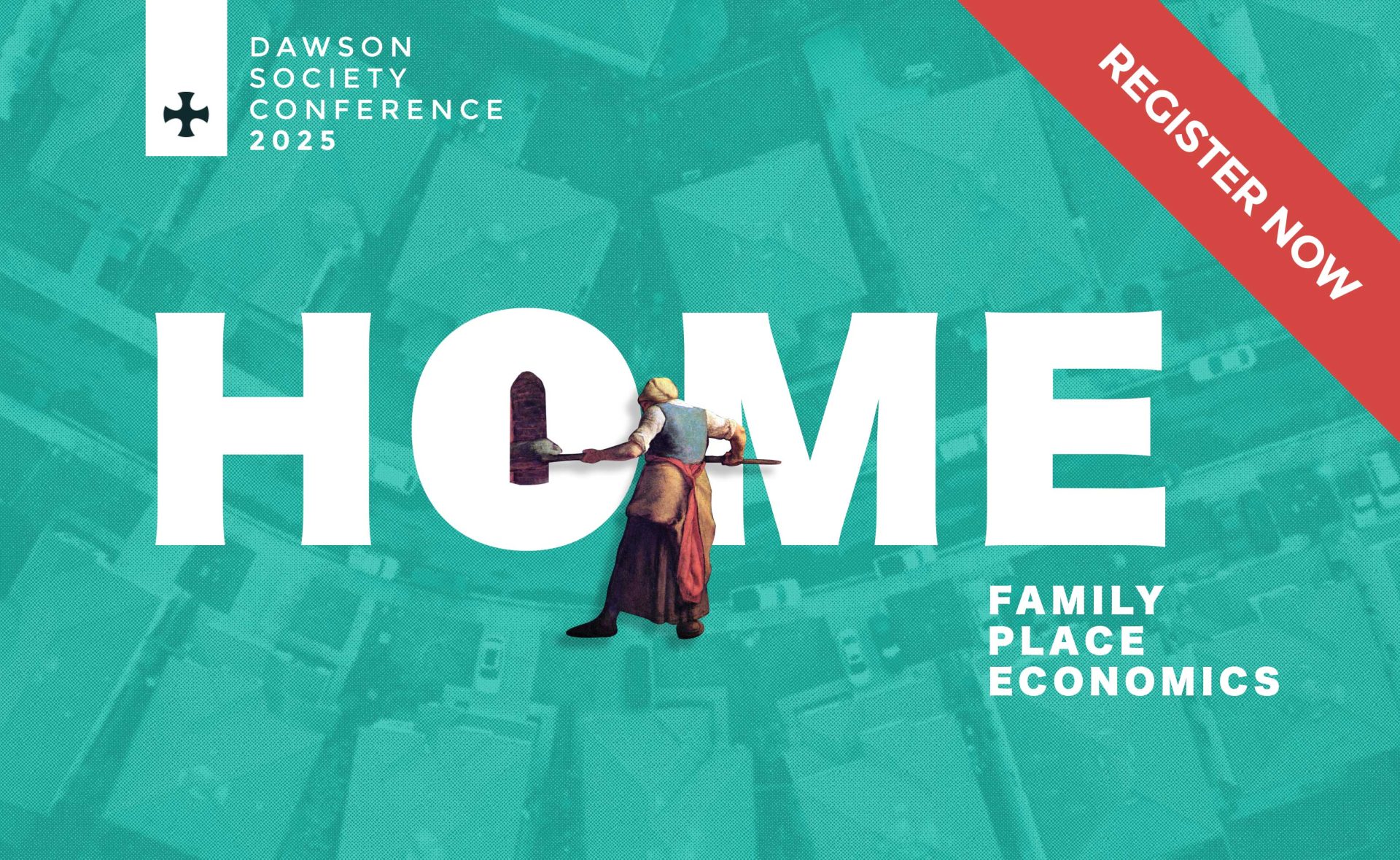
Home: Family. Place. Economics.
It is less than a week away!
If you’ve not registered yet for the Home conference, now is your chance to do so!
Many people have told us how prescient the theme is that we’ve chosen for this conference – ‘Home: Family. Place. Economics.’ The more we hear these discussion, and the more we look over the list of papers that have been submitted, the more we are convinced of the importance of this conference and events like it.
We are pleased to release the full schedule of the conference and the abstracts of the papers which you will find below.
Please also be aware that registration includes morning tea, lunch, and afternoon tea for the Friday and Saturday of the conference.
The conference will be formally opened in prayer by Archbishop Timothy Costello on the Thursday night before a FREE public lecture from Marc Barnes, who we’re bringing out from the United States for the occasion. Even if you can’t make it to the conference in full, this is one event that you will not want to miss. If you’re coming to that, please register too (again, it is free – but it is useful for us to get a sense of the numbers).
The conference will be hosted at Tannock Hall of Education on the beautiful grounds of the Fremantle campus of the University of Notre Dame Australia, and will feature other keynote speakers Anna Krohn OAM, and Emeritus Professor John Kinder OSI FAHA. More information regarding the conference can be found in the frequently asked questions (FAQ) on our website here.
Registration, both for the free public lecture and the conference itself are available here. Day registrations for either the Friday or the Saturday are also now avaliable.
Conference schedule:
Thursday 10 July

Friday 11 July

Saturday 12 July

Abstracts of conference papers
Fr Mark Baumgarten STL
Pilgrimage: The Tension Between our Worldly and Heavenly Home
“Saints live amid the ordinary circumstances of their times and places. And it seems to me that the holiness of a saint can sanctify a place in some ways, too, leaving behind a kind of living memory of God’s extraordinary grace, and extraordinary kinds of cooperation with it.” – JD Flynn
“If you are a Christian, no earthly city is yours. Even if we control the world, we are still immigrants and foreigners, because our citizenship is in Heaven.” – St John Chrysostom
Christ proclaimed the Kingdom of God, and his followers strive, with his grace, to live out this Kingdom in their everyday lives. However, the Kingdom that Christ proclaimed is both now and not yet, in that it shines forth in this world in moments of grace and lives of sanctity, and yet its definitive fulfilment will not be until the life to come. This tension leaves the followers of Christ seemingly split, with one eye on present engagements and one eye on our heavenly home. This presentation will explore this tension, with its implications for our attachments to persons and places in this life, and how we might strive for Heaven through our present-day callings.
Paul Catalanotto
Bluey’s Bandit, play, and the little way.
The unexpected and unprecedented success of the Australian kids TV show “Bluey”, about a family of four blue healer dogs living in suburban Queensland, warrants an investigation into the title character’s father, Bandit. This paper examines the artistic and literary interpretations of fatherhood through Bluey’s father Bandit, arguably the real hero of the show, as it relates to the theological act of play alongside St. Therese of Lisieux’s “Little Way.”
Bandit depicts modern Australian fatherhood as a joy and adventure. Bandit’s selflessness, humour, and humble devotion transform simple activities like taking out the trash, playing cricket, being present, and eating meals together into moments of grace, embodying St. Therese of Lisieux’s “little way.” Bandit lives the “Little Way” through the play with his children, whereas the home then serves as the sacred space where both play and the Little Way occur. An inspiring look at the importance and irreplaceable nature of fatherhood, this four-legged Aussie “Dad” is a refreshing and counter-cultural reflection of who is in the Australian home and why audiences worldwide have embraced Bandit.
Benedict Chang
Home in the age of Artificial Intelligence
Artificial Intelligence (AI) is changing almost every area of our society including our lives, homes and families. Today, AI is making decisions for us from the music that we listen to, to the routes that we take when we travel. It can converse with us, generate acceptable short stories, scripts and images. AI is everywhere even if you do not recognise it. AI is used in many different types of technology including smart phones, social media, smart home devices, etc. Knowingly or not, we have already welcomed some form of AI into our homes which is being use by our family members. AI is neither good or bad and it can be designed and used for good or evil purposes. We can use AI for the glory of God and for the betterment of our society, homes and families or we can use it for sinful and harmful means that will destroy our society, homes and families. While the benefits of AI are many, the threats that it brings to our homes and families are real and must be addressed. To do this we must have an understanding of how AI will affect our society, homes and families. In this paper we will discover some of the benefits and the dangers that AI brings to our homes and families. We will then explore how AI is changing us as individuals, our homes and families and how we can build our homes and families in the age of AI.
Harry Cunningham
“The World’s Longest City: Exploring Perth’s Sprawl and the Commercialisation of Home
In this lecture, documentary photographer and filmmaker Harry Cunningham presents his photo series The World’s Longest City, using Perth as a case study to examine the effects of urban sprawl on the livability of the city, while linking these observations to broader themes of home, identity and sense of place. Through symbolic urban imagery of barren streetscapes, mass-produced houses, and endless roads, the series challenges viewers to rethink Perth’s everyday, often overlooked scenes. As an issue deeply intertwined with Perth’s identity, The World’s Longest City raises broader concerns about the city’s development, priorities, and long-term liveability. Cunningham’s work encourages reflection on the values shaping Perth’s growth and questions whether homes are increasingly becoming viewed as commodities to be bought and sold, rather than places to live and belong.”
James Davidson
Intermediaries can add value: How home insurance can promote a common good
When I send a small amount of money to my insurance company every month and only occasionally get paid back a moderate sum after some rare and unfortunate event it is easy to assume that we are playing a zero-sum game. The idea of expected value is a common assumption and has come to prevail in mainstream economics, which is why many consider insurance to be a zero-game. In their paper called “Insurance makes wealth grow faster”, Ole Peters and Alexander Adamou draw on their backgrounds in physics and mathematics to provide fresh ideas under the banner of ergodicity economics. In the ‘Insurance’ episode of the podcast Good Money, it seems that the hosts Jacob Imam and Marc Barnes mistakenly assume that insurance is a zero-sum game. They claim that the longevity of the insurance companies is evidence that they are good at gambling. Peters and Adamou use a similar argument to show that actually the ongoing ubiquity of voluntary insurance contracts raises questions about the expected utility hypothesis itself.
If the insurance company is profitable does that mean the insured person must be losing money? What does ergodicity economics have to say about gambling? Is it never possible for the seller and buyer to both profit from a series of exchanges? While it certainly can be argued, with Imam and Barnes, that intermediaries like insurance companies prevent authentic human connection and that almsgiving is an exchange of more than money, in this paper I will argue that mutually profitable insurance is possible and explore the possibility that the fundamental mechanism can be made to work at a scale small enough to facilitate encounter and build community.
Elena Douglas
Why we need the Italian Public Happiness Tradition to help us restore Truth, Goodness and Beauty to our homes, the marketplace and civil society
This paper offers the lessons of the Italian Public Happiness and Civil Economy traditions as a source of inspiration in reanimating our domestic, political, business and economic life. This lost tradition, with its roots in the medieval towns, its monasteries, its arts and trades, offers a better solution to the challenges of modernity and commercial society than the economic and political philosophy articulated by the French or British Enlightenments. The writing of two of the principal exponents of the Public Happiness tradition Antonio Genovesi (1713-1769) and his pupil Giacinto Draghonetti (1763-1846) will be featured. Their ideas provide a basis for flourishing, for the wise Statesman to pursue the Public Happiness and support flourishing in all the spheres – home, market, polity and society – ordered to the Good, the True and the Beautiful.
The Civil Economy/Public Happiness tradition sets out from an anthropology that includes the fall, and admits to improvement if not perfection based on the capacity of the institutions that surround the citizen to cultivate virtue. From this anthropology stem ideas of the potential for commercial-society to be based on reciprocity, sharing gifts, mutuality and artistry as well as self-interest and self-love. In Genovesi’s writing and in Dragonetti’s short book, A Treatise on Virtues and Rewards (1766) the civil society’s purpose, its telos, was the formation of virtuous citizens who work together for the common good, in conflict with successful trade and commerce. This vision for the domestic sphere, the commercial sphere and the public sphere all being sites for happiness offers an integrated way of ordering contemporary lives to first things.
The paper will draw on the primary resources and translations of Genovesi and Dragonetti, then consider some of the contemporary commentary on the relevance of the ideas to us in our homes, in our work and in our local communities and society including by offering some real world examples of happiness in all of the spheres, domestic, commercial, civil and public.
Clara Geoghegan
Who pays for the children?
In the Harvester Decision, (1906) Justice Higgins of the Arbitration Court determined the amount that constituted fair and reasonable wages for an unskilled labourer to support himself, a wife and three children. This became the basis of the national minimum wage system in Australia. It is rumoured that Justice Higgins, not a Catholic, had read Rerum Novarum, and that it shaped his views. Abandoning the “family wage” in determining the minimum wage in the 2015 National Wage Case put an end to any concept of “family” in government economic policy. The actual transition, however, began with the Fraser Government in 1976 when child endowment and family tax deductions were replaced by “family allowance” and transitioned from being a tax benefit to a social security payment. This paper examines the history of economic support for families in Australia, its decline, and what can be done for the future.
Taylor Glass
“A Home? In this Economy?”: How our Broken Monetary System created the Housing Crisis and How Harder Money Solves It
Australia has a housing crisis. According to the Australian Bureau of Statistics, the average dwelling in this country is now above $1,000,000. High-wage earners can afford this luxury. But many young people are left wondering what hope there is for home ownership in their lifetime. Will prices come down? Not according to Australia’s Housing Minister Clare O’Neil, who stated that the government is “not trying to bring down house prices” but “wants house prices to grow.” Policies like negative gearing only fuel additional investment in Australian housing, driving prices up further. In this paper, I will explore the ways in which the Australian housing market has become distorted through our broken monetary system. And I will propose Bitcoin – yes, Bitcoin – as a way for every Australian to overcome this unjust and unsustainable system.
Dr Thomas V. Gourlay
“And who is my neighbour?”: The suburbs as spiritual crisis
Life in the modern suburb is often characterised by a kind of social and spiritual atomism. In an address at a conference held in 2009 to mark 80 years of Town Planning Law in Western Australia, the Hon Wayne Martin, then-Chief Justice of Western Australia noted that Perth had become ‘a network of dormitory suburbs linked by freeways in search of a soul.’ But what is it about the suburb that results in this sense of soullessness?
This paper will interrogate how suburban spatial, economic, and cultural configurations erect obstacles to the integral development of persons and communities of persons, inhibiting solidarity, perpetuating individualism and atomism, and distort human relationships.
Drawing on Pope St John Paul II’s notion of ‘structures of sin’, the paper argues that the built environment of suburbia can embody disordered values that marginalize the poor, neglect the common good, and fracture the bonds of human fraternity. This paper proposes a mode of reimagining of suburban life that fosters encounter, ecological responsibility, and genuine neighbourliness, pointing toward an integral human ecology grounded in justice, communion, and care.
Dr Peter Holmes
Masculinity and Home
To combat the pre-existing order (see “patriarchy” in Stearns), industrialists and the governments supporting them engaged in propaganda to realign masculine identity with the work he does and the salary he brings home. At least a part of this propaganda has used Genesis 3 to justify the separation of ‘labour’ between the man and the woman. This interpretation, namely that man labours in the field and woman labours in childbearing, has been offered as a biblical foundation for this identification of the man with his external labour.
The Church has interpreted this passage in relation to ‘man’ in response to the impact of the industrial revolution on family life. Pope Leo XIII, for example, speaks of a man’s right to work in order to provide for his family. Not that woman and children do not have this right, but that they access this right through the man. Church documents assume that the right to form a family and have access to the means to provide for that family are, in a society based on monetary recompense for labour which is traded for necessary goods, primarily accessed via the husband’s work. Modern society does not share these assumptions. Women now willingly and eagerly enter and thrive in the workforce as equals, and their contribution in almost every field is impossible to ignore. This paper will draw from some insights on the impact of the industrial revolution on our understanding of and expectations of masculinity, outline the way in which ‘equality in the workplace’ has challenged this industrial perspective of masculinity, and draw on Catholic anthropology and Catholic Social teaching to propose some positive perspectives and potential in the new order. It will propose that Masculinity not only begins at home, but it also finds its primary definition and vocation in the home.
Emeritus Professor John Kinder
The words of home and the home of the Word
Everything needs a place, an intersection of time and space in which we are formed and grow, a place that sends us forth and welcomes us back. The words for ‘home’ in all the world’s languages speak of protection, security, warmth. The place we call home gives us the words with which we encounter the world. Language is one of the defining characteristics of home: at its origin language grows from the land and defines those who can call the land home. Though languages are used to divide and exclude those who does not belong to our home, they exist to bring individuals into communion through communication, making our heartstrings vibrate in a single melody. This is uniquely and universally true of the house, or home, of God. For when the Word became flesh, he ‘pitched his tent among us’.
Anna Krohn OAM
The Paideia of the Hearth: Some Cultural & Theological Sparks
For centuries and across many cultures the hearth of the home has burned physically, culturally and etymologically as the “focus” of the home. It has served as source of warmth, nourishment and a gathering space for the family, its visitors, and also as a place of solace and hospitality to strangers.
Anthony Krohn
Concepts of House and Home: Domus in Christian Tradition – With illustrations from scripture and literature
Human beings were created for communion with God in a true home—Paradise. Yet, we now labour in exile, inhabiting a world marked by alienation, struggle, and estrangement. Despite this, the deep human longing for home persists: a place of belonging, peace, and relationship. This longing manifests in various human contexts—personal dwellings, families, religious communities, and academic colleges—all of which can serve as echoes of our intended dwelling with God. Christian conceptions of home build upon classical understandings of oikos and domus, not merely as physical shelters, but as spiritual and communal spaces shaped by love, hospitality, and meaning. Home means hospitality, a place where the stranger becomes guest and friend. The Christian ethic of hospitality transforms the home into a site of neighbourly love and welcome.
Homelessness then, in this theological vision, is both a painful reality and a prophetic sign. It reflects the transient nature of earthly life and reminds us that “here we have no abiding city.” As homo viator—pilgrim humanity—we journey from God and toward God, seeking a final homecoming. Death, then, is seen as the ultimate homelessness, a severance from all earthly dwelling.
This theme of home resonates throughout Scripture and literature—from the Wisdom literature of the Psalms, Job, and the Song of Songs, through to the Gospels and forward into the writings of J. R. R. Tolkien. These texts reflect humanity’s exile and yearning, offering images of home that both console and direct us toward the eternal home that awaits in God.
Brad Le Guier
Pilgrims of Home: Wendell Berry’s fiction and a hope for home
Where are we heading, or where should we hope we are heading, when we say “I’m going home”? What can rightly be called ‘home’? American farmer and writer Wendell Berry notes that the modern Western world’s conception of ‘home’ is a place ultimately symbolic of status, where one can escape from work, and “forget where he is and what he has done.”
Berry’s critiques might come as an augur of despair for modern suburbanites, as he piercingly examines what is, for them, the only reality they have ever known. This concept of home – a diamond-studded escape from reality – appears unhospitable and unfit as a brick-and-mortar ‘domestic church’, regardless of the number of diamonds. Particularly significant among his writing, Berry gives his critiques form in the development of Port William – the township, indeed ‘membership’, at the heart of his fictional works. Berry’s fiction explores the lives of her ‘members’ and of Port William herself, as she and they persevere through the events of the 20th Century while remaining present to life as a community, and their unique struggles as persons. This paper seeks to explore how Port William, as perhaps the central character of Berry’s fiction, gives an image of what we might hope for in ‘home’. First, how Port William and her members give an image of the realisation of Catholic social teaching in community life. Second, perhaps to give hope to downtrodden suburbanites, how Port William responds to and perseveres through cultural change and suffering across the 20th century, especially as it challenges the existence of Port William. Third, to explore, in this Jubilee Year of Hope, how Port William gives an image – “as in a mirror dimly” – of home as a destination of pilgrimage.
Milly Main
In defence of the homely: earnest architecture and urban design
In public architecture and urbanism, the label ‘kitsch’ is often used to discredit expressions of warmth, sincerity and tradition in the built environment. This reveals a modern discomfort with innocence and joy – qualities essential to creating places that feel like home. In Perth’s 1990s and 2000s New Urbanist developments in East Perth, Jindalee, Subiaco and Bunbury, where public squares, verandahs, arcades and pitched roofs evoke a more human-scaled and joyful civic life, ‘insiders’ in academia and design practices often deride these gestures as nostalgic or inauthentic. Yet far from being regressive, they reflect an earnest attempt to restore meaning and belonging to public space. Drawing on the thought of Léon Krier, as well as classical and conservative ideas, this paper defends the ‘homely’ – in both its architectural and emotional senses – as a vital quality in urban design. A human-centric approach to urban design is conservative in that it respects the folk memory embedded in traditional forms and patterns. It recognises that ornament, symmetry and enclosure are not superficial, but serve a deeper moral and social function: to comfort, to orient and to invite participation. Rather than viewing tradition through the lens of irony and cynicism – with ‘hard’ hearts – we must recover a language of architectural earnestness – one that embraces beauty, familiarity and the shared delight of place as central to civic life.
Dr Philippa Martyr
A Woman’s Place Is Not Being Homeless
If a woman’s place is in the home, then what happens to her when she doesn’t have one? Does she disappear? Or do we simply cease to see her? The housing crisis in Australia has now made women aged 55+ at greatly increased risk of homelessness. Many other factors contribute to this, such as domestic abuse, divorce without a proper financial settlement, family estrangement, job loss, childlessness, and lack of financial literacy. So how does this sit with the Christian profession of the family as the domestic church and cornerstone of a stable society? Do we blame these women – who are often already victimised – for their perceived failure to conform to a too-specific set of ideas about their role in society and in the Church? Or is this where the Church can creatively direct its resources to help them? This paper will look briefly at some small creative options that are being trialled to help these women, including a secular project in Queensland called Sharing with Friends.
Eliza Matthys
Is home where the heart is?: On the industrialisation of nurture in Australia.
Nurture in Australia is increasingly outsourced to professionals working in large efficient institutions. This paper will compare the home and the institution as places of care and nurture. In light of the royal commission into aged care and child care trends in Australia it will be argued that the home, the family, or home like structures provide a higher quality of care. The home as a place of care ought to be supported, championed and made more economically viable for broader Australians. The idea that caring for one’s own children and elders as a revolutionary act will be explored.
Daniel Matthys
Priest, prophets and kings: Restoring Christian dignity to our homes.
‘An Englishman’s home is his castle’, or at least so the saying goes. But this expression has a very real resonance in the theological understanding that Christians are baptised into the offices of priest, prophet, and king as well as the responsibility the Church recognises for parents. But what does this office of kingship mean for the baptised? And how might the role of a Christian kingship be authentically embodied in everyday life? Our homes are a (perhaps even the) primary place in which our office of kingship is actualised. Christians are offered in the Gospels two models of the king, that of Christ and that of Herod. This paper will argue that cultural and economic structures of modernity, primarily that of consumerism, work to promote a herodic model of kingship in our homes and thus pervert a proper ordering of home life. The paper will offer suggestions of antidotes to modern conceptions of home and homelife through an embrace of the baptismal office of an authentic, Chrisitan kingship.
Anne-Marie Quinn
Rise, Let Us Be on Our Way: Pilgrims on the journey home.
“Rise, let us be on our way”—a compelling invitation from Pope John Paul II—captures the essence of the eternal human question, “what am I to do?” For the Christian with an ever-present sense of the incarnation and suffering of Christ, the answer is simple- to seek a life conformed to Christ and directed towards our heavenly home. The restlessness of the heart described by St Augustine highlights that the journey towards our heavenly home, or pilgrimage is a universal human experience. Pilgrimage has several key elements: it requires the practice of contemplation and silence to hear the Lord’s voice, second; it rejects stagnation and demands a response that moves us to act, and third; it is a deeply personal journey, for in the end each soul will stand before God alone. What then for those outside the People of God? For many, ideas of home are deeply entrenched in country or family or even a physical place. A sense of belonging, safety and love permeates the secular view of home, often shaped by cultural and socio-political expectations. Secular man’s happiness and freedom lie in establishing his own home, without any reference to the transcendent. This casual indifference tends to lead man generally in two directions: either the presumption of salvation or to despair. Both sins against the virtue of hope. As we go along our way, we understand therefore that we cannot live without the hope of God’s grace and mercy. Just as when we undertake a pilgrimage, we carry the intensions of our loved ones, as a community of the faithful we hold the great responsibility to especially carry those who cannot hear the Lord’s voice. In our faithful cooperation in God’s grace, we can help our brothers and sisters to also journey towards their heavenly home.
Symon Smyth-Kirk
The Church as Home: The Liturgy Wars and the search for the Catholic Domus
The contemporary skirmishes surrounding the Church’s liturgical practice — commonly referred to as the ‘Liturgy Wars’ — highlight not only a clash of opposing ideas, but also a confrontation over the principles of identity, authority, and the question of what constitutes the legitimate place of liturgical diversity in the life of the Church. This paper examines the historical place, legitimacy, development of liturgical disputes, and how this can be addressed. From the liturgical reform movement of Dom Prosper Guéranger, the varied and often opposing interpretations of Sacrosanctum Concilium, and in recent years, the tension or elation brought about by Summorum Pontificum and Traditionis Custodes, this paper will argue that authentic liturgical expression is inseparable from the Church’s perennial doctrine and ecclesial integrity, not simply an expression of aesthetics or preference. Drawing on sources such as Dom Alcuin Reid’s The Organic Development of the Liturgy and Benedict XVI’s The Spirit of the Liturgy, this paper proposes that the Catholic response to the Liturgy Wars must transcend the ideological trench warfare of the past decades and embody a pastoral charity rooted in truth, tradition, and empathy — from all, to all. A vision of the Church as Domus — a true home for the people of God — requires a sincere and genuine charity towards the varied and legitimate diversity of liturgical rites and practices which have, and will, organically develop. By fostering charity despite disputes over hermeneutics, and by prioritising Communion over coercion, the Church may yet heal her dangerous divides and reassert her liturgical patrimony as a true sign of unity and Home in the midst of a hostile world.
Dr Matthew John Paul Tan
Every Home Must Burn – Migration & Eschatology
This paper explores the migrant’s transition from one home to another in light of the last things. It argues that the question of migration is not so much a sociopolitical question but a question of desire, in which the heart burning with desire underwrites the process of migration to the country of domicile, as well as the loss and nostalgia for the country of origin. It will argue that the heart’s burning desire constitutes a golden thread that both problematises and suggests an opening for the migrant’s experience of a loss and recovery of home. The paper will then problematise the heart’s desire against the implications of Joseph Ratzinger’s analysis of belief in the person of God (made in his Introduction to Christianity), and argue that the substance of the migrant’s heart’s desire constitutes a radical and painful recalibration of the locus of stability away from one home to another. Building on Ratzinger’s observation, the paper submits that this recalibration makes sense and finds its telos when set against an eschatological horizon, in particular when considered against the categories of death, judgement and the beatific vision, in each of which the motif of burning desire constitutes the living core.
Samuel Vermeulen
Exploring ‘continual conversion’ in the face of climate nihilism through Tim Winton’s Juice.
West Australian author, Tim Winton, in his 2024 novel, Juice, confronts his readers with a post-climate-catastrophe world from the perspective of desert-homesteader settled in North-Western Australian. The novel is a meditation on the many facets of ‘climate nihilism’; which is an attitude of hopeless resignation toward the inevitability of climate-collapse. This resignation takes many faces throughout the novel; from sympathetic faces of homesteaders who move southward after destructive weather-events, to the less-sympathetic faces of elites who hoard their resources in fear, to the cold faces of soldiers who have dedicated themselves to assassinating said elites. The world of Juice is a world where power, divorced from responsibility, trust, and meaning, knows only how to be used violently.
These nihilistic conditions weigh upon the unnamed protagonist who, from the beginning pages of the book, is held hostage and interrogated by an unknown crossbow wielding assailant. Faced with death, not just in the environment, but also at the tip of the crossbow, the protagonist provides a potential final confession of his life. Aspects of the Church’s recent notion of ‘ecological conversion’ come to light throughout his narration, from a confession filled with compunction regarding ecological sin, to a confession of awe at the beauty of God’s creation, to his hope-filled and defiant confession on the final pages of the novel; “That humans are not just destroyers. We’re makers.”
Adam Wesselinoff
The cosmos in my living-room: Re-domesticating art after the avant-garde
“I now require this of all pictures, that they domesticate me, not that they dazzle me.” – Ralph Waldo Emerson. The modernist avant garde’s quest to eliminate tradition-constituted images of nature and the person culminated in the art of Marcel Duchamp, leaving us in a world without “world pictures.” Contemporary art then extended and internalised avant garde iconoclasm as the only possible orientation for art, using performance, installation and conceptual media to provoke transitory events and experiences of the sublime, rather than the beautiful. By shocking the viewer into alienation from sense experience, contemporary art makes the gallery a site of artistic world-denial. Paradoxically, today we also live in a “golden age of visualisation” due to the “techno-genesis of virtual worlds” utterly reliant on images, producing a present-day art of alienated “pictures without worlds,” according to the theorist Žarko Paić.
In this paper I will draw on the Victorian Arts and Crafts Movement—in particular William Morris and the Australians Napier and Christian Waller—to argue for the home, not the gallery, as the “world” within which pictorial art can find itself again. Through the recovery of the minor arts, muralism, textiles, wallpaper and furniture-making, the Arts and Crafts Movement sought to reconstitute nature in the domestic sphere. They sought to resist the shoddiness, ugliness and atheism of 19th century industrial society, in part by re-establishing the priority of the home as the place where sociability, with its attendant aesthetic dimension, is learned. Developing their critique, I will show that the dazzling flow of virtual images can be resisted by refiguring a benign and meaningful cosmos, indoors. Far from being a nostalgic recovery, we must re-domesticate art to provide a place for the stable cultivation of gentle (and essential) human capacities like intimacy, attentiveness, patience and piety.