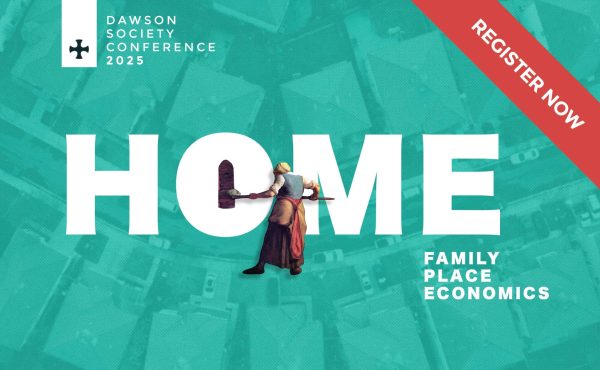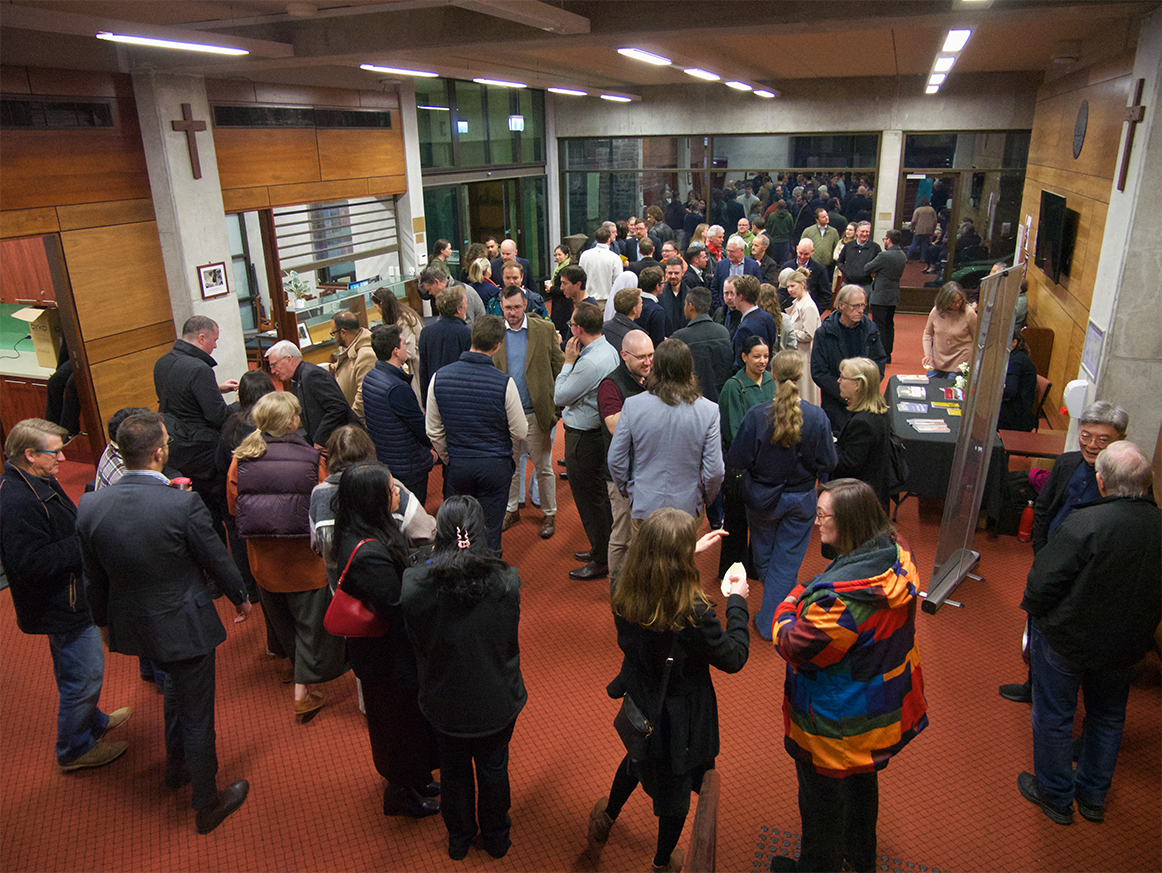
The recent Dawson Society conference was a real hoot. First conceived in a planning discussion in 2021 with a view to be hosted in 2022, the theme, ‘Home: Family. Place. Economics.’ seemed to become more pertinent with every passing month, and by the time it rolled around, and we were listening to the various presentations we were convinced that this was indeed a pertinent theme, and that there was much more that remains to be considered.
‘Home’, wrote the great T.S. Eliot in the second of his Four Quartets, “is where one starts from.” For all of our modern propensities to avoid particularities, or the constraints of time and space, the home is unavoidable. It was fitting that that this conference was hosted by the Christopher Dawson Society for Philosophy and Culture. While Dawson himself did not write explicitly on the home, as a cultural historian he was keenly aware of the ways in which world events and ideas or concepts shape the ways in which people live, and vice-versa.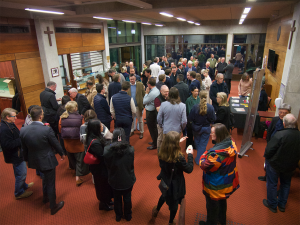
Much of the work of the Dawson Society historically has focused on the promotion of the contemplation of beauty, goodness, and truth. A great many of our past events have sought both to celebrate and appreciate these properties of being and to examine them as they are manifest in particular aspects of cultural endeavour. Another aspect of the work of the Society has been to critically examine, with the eyes of faith, the culture within which we live here in Perth, Western Australia at the beginning of this twenty-first century. The goal here is not to engage in a thoughtless and reactionary conservatism, nor to mindlessly celebrate an ill-defined ‘progress’, untethered from the tradition. But rather, the goal has been to sift our experience, so as to develop an awareness of how the broader culture shapes us, and how we in turn can be agents for change within that culture, not so as to make a political program of the faith, but so as to live authentically and pass on that faith as a reality that is living and vibrant. And this has led us to the topic of the conference, ‘Home: Family. Place. Economics.’
Many of us in the comfortable if somewhat sprawling suburbs of Perth, Western Australia tend to be able to get by with nary a thought of the home. Once we’ve established it, our focus tends to be elsewhere – but this habit of being in the world, one which is particularly privileged came unstuck in the midst of the covid pandemic, where confinement to our homes brought this reality to the forefront of our collective consciousness. Added to this, the rising global social, political, and economic instability and the concomitant housing crises, together with increased awareness of environmental crises all bear testimony to the fact that it is high time for us to give a more critical eye to the issues which we face in this, one of the most intimate aspects of our lives.
This crisis should not simply be seen as a cause for panic. “A crisis,” wrote the philosopher Hannah Arendt, “forces us back to the questions themselves and requires from us either new or old answers, but in any case direct judgments. A crisis becomes a disaster only when we respond to it with preformed judgments, that is, prejudices. Such an attitude not only sharpens the crisis but makes us forfeit the experience of reality and the opportunity for reflection it provides.”[1]
And this was the goal for our conference: To think clearly and critically about the situation within which we find ourselves, and to do so in the light of what is revealed to us in the Person of Jesus, in the light of our faith. And, in many ways, I am glad to report that this goal was achieved, and then some.
We’ve been very glad to inform readers and subscribers to our newsletter of some of the coverage which our conference attracted, at Sydney’s Catholic Weekly newspaper, and in the newsletter of the Thomas More Centre. You can read these by following the links.
Attendees of the conference, eager to follow up on many of the insights proffered by conference presenters has suggested that a short reading list be circulated with a few suggested texts. A number of our presenters were happy to oblige, and so we are happy to offer these to you – eager too for other suggestions which might emerge (please send us any further suggestions!)
Emeritus Professor John Kinder
Paul Claudel, The Tidings Brought to Mary, Human Adventure Books, 2009.
Luigi Giussani, Why the Church? Montreal, Queens-McGill University Press 2001.
Henri J.M. Nouwen, The Return of the Prodigal Son: A Story of Homecoming, Darton, Longman and Todd, 1994.
Tim Winton, Cloudstreet, Penguin 1991.
Dr Philippa Martyr
Philippa Martyr, When getting out is the only way to go on, The Catholic Weekly, 7 December 2023, https://catholicweekly.com.au/when-getting-out-is-the-only-way-to-go-on/
For any budding hedge lawyers and armchair experts:
https://www.legalaid.wa.gov.au/find-legal-answers/family/dividing-property/how-court-decides-property-cases (note especially the June 2025 amendments)
James Davidson:
Ergodicity Economics blog https://ergodicityeconomics.com
The Dao of Capital by Mark Spitznagel (published 2013)
Antifragile by Nassim Taleb (published 2012)
Taylor Glass
Broken Money – Lyn Alden
The Bitcoin Standard – Saifedean Ammous
What Went Wrong with Capitalism – Ruchir Sharma
Brad Le Guier
Berry, Wendell. A Place on Earth. Counterpoint, 2001. (n.b. first published 1967).
Berry, Wendell. Hannah Coulter. Counterpoint, 2004.
Stanford, Thomas W. “Membership and Its Privileges: The Vision of Family and Community in the Fiction of Wendell Berry.” Logos 14, no. 2 (2011): 118–30. https://doi.org/10.1353/log.2011.0016
Paul Catalanotto
Hugo Rahner. Man at Play. (Herder and Herder) 1972.
Dr Matthew John Paul Tan
Tan, Matthew John Paul (2024) “Loss in Light of the Last Things: Christianity, Eschatology and Grief in Inside Out“. Religions 15.8, p. 897.
Milly Main
Leon Krier, Architecture of community
Philip Bess, Till We Have Built Jerusalem.
Dr Tom Gourlay
Thomas, R. H. (1997). “From Porch to Patio: The Desire for Privacy and the Need for Community.” Iowa Heritage Illustrated 78(2): 52-61. https://pubs.lib.uiowa.edu/ihi/article/id/1398/download/pdf/
Schindler, David L. (2000). “Homelessness and the Modern Condition: The Family, Evangelization, and the Global Economy.” Communio: International Catholic Review 27(3) pp. 411-431. https://www.communio-icr.com/files/schindlerdl27-3.pdf
Schindler, D. L. (2002). “Religion and Secularity in a Culture of Abstraction: On the Integrity of Space, Time, Matter and Motion.” Pro Ecclesia 11(1): 76-94.
John Paul II (1987). Sollicitudo Rei Socialis: The Social Concern – On the twentieth anniversary of the encyclical Populorum progressio. https://www.vatican.va/content/john-paul-ii/en/encyclicals/documents/hf_jp-ii_enc_30121987_sollicitudo-rei-socialis.html
[1] Hannah Arendt, Between Past and Future (New York: Viking Press, 1968), 174-75.