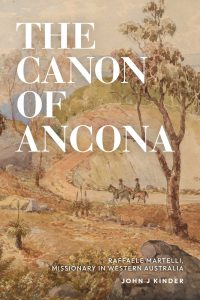
The Canon of Ancona: Raffaele Martelli, Missionary in Western Australia, By John J. Kinder, Perth, University of Western Australia Press, 2026 358 pp. $45 (paperback). ISBN: 978-1-76080-321-6
The announcement of the Christian fact reached this wide, brown, flat, and ancient land fairly recently. Arriving with the first European explorers and colonists the Christian proclamation, and the efforts to announce it here in the antipodes, has from the beginning been tainted by its association with the ideology and practice of colonialism. This all makes for a complex history and a rather ambiguous account of any ‘success’ of the Christian mission—indeed the word ‘mission’ itself is itself loaded with all manner of fairly repugnant connotations in light of its usage and the manner in which certain ‘missions’ conducted their business with respects to the Indigenous peoples of this land. And yet despite all this, the history of the Church in this great mass of land is replete with stories of heroic virtue and apostolic zeal. The recent publication of The Canon of Ancona: Raffaele Martelli, Missionary in Western Australia, by Professor John J. Kinder tells one such story.
 To our impoverishment, Martelli’s story is one which has been, to date, relatively unknown—a sorry situation which Professor Kinder’s book will hopefully go a way to remedying. As Kinder details in the book, Martelli (1811-1880) was a man of immense learning and culture. A Catholic priest and professor of rhetoric and eloquence at the seminary in his native Ancona, on the Adriatic Sea, Martelli lived a life of relative comfort as a Canon of the ‘Illustrious Collegiate Church of Santa Maria della Piazza and San Rocco’ while engaging in his academic duties as professor. By way of certain misadventures on his part Martelli was caught up in what was, ecclesiologically speaking, the wrong side of the politics of the time in matters concerning the developing modern nation state and what would eventually become the unification of Italy. In the happy providence of coincidence, as something of a consequence of Martelli’s political activities he spent some time residing (and teaching) at the monastery of Monastery of Santa Scolastica in Subiaco (Italy), at precisely the same time as the missionary monk and bishop, and founder of the New Norcia mission in Western Australia, Rosendo Salvado happened to be visiting, raising funds and recruiting missionary monks to join him. The friendship that Martelli formed there with Salvado set him on a trajectory that saw him live out nearly half of his life on foreign shores, and die as a missionary in the Swan River Colony.
As with so many other tales of the early Church experiences in Western Australia, Martelli’s experience is one punctuated with a number of wild anecdotes—some amusing, some shocking, some altogether inspiring. His desire to participate in the missionary work of his friend Bishop Rosendo Salvado at New Norcia, was one which was frustrated from the moment of his arrival in the Swan River Colony on in 1853. While his intentions in coming to Australia were to share the news of the Christian event to those indigenous persons and communities in the region, Martelli, bound as he was to the ecclesiastical laws of the day and thus in the charge of the Bishop Jose Serra OSB, Apostolic Administrator of Perth at the time, found himself occasionally stationed in Fremantle, Newcastle (Toodyay), Northam, or other locales across the region ministering primarily to the European populations here, prisoners and free settlers, but rarely ever the Aboriginal persons he’s hoped to be encountering. A man of robust constitution, Martelli served the people of the Swan River Colony in Western Australia for some 27 years, never returning to his beloved Ancona, but instead giving of his whole self to the LORD in giving himself to the people who were given to him.
The story is an extraordinary one and one worth reading, not because Martelli was some sort of miracle worker or of renowned sanctity, holy though he likely was. What makes Martelli’s story so fascinating is the sheer fact of it. As Kinder so eloquently tells it: Here is a man, a man of his day, a man of significant intelligence and accomplishment, but a man with all sorts of struggles and foibles. A man who was moved to cross the world, to give himself, his whole self, to the LORD in and through his gift of self to the people who were given to him in the bizarre backwater of the fledgling Swan River Colony. It is in fact, just another episode in the history of this seemingly random group of people who encountered a fact, a man who, in the words of Pope Benedict XVI, ‘gives life a new horizon and a decisive direction’.
Martelli is yet another link in the chain and Professor Kinder has done us all a tremendous service in telling his story. Immanently readable, inspiring, and deeply edifying, The Canon of Ancona is not just a biography of an interesting figure in the early days of the Swan River Colony, it is the story of how the Christian fact was lived, and was communicated in the most unsuspecting of circumstances.