The following is a guest post by Mr. Adam Wesselinoff. The Dawson Society welcomes all contributions that work to promote the goals of the Society, principally intelligent engagement, open to spiritual realities, with cultural and philosophical ideas. Contributions, comments, complaints etc. can all be directed to
For men, medievalism is a bit like prostate cancer: most eventually get it but, thank god, it’s not usually what kills you. As for women, medievalism is more like coldsores: invisible, except every so often you get an identical, iconic flare-up (John Everett Millais’ Ophelia to Taylor Swift, for instance). Either way, medievalism is a sickness, but a “sickness unto life”. It’s caught by those who William James called “sick souls”, people who find the evil of the world intolerable and need to be “twice-born” through radical pessimism in order to be happy. No doubt there are a few such people among the friends of the Dawson Society, and they ought to pay a visit to the Art Gallery of Western Australia’s current exhibition of medievalist works from the State collection, Chivalry is Dead?
I say medievalist and not medieval, because Chivalry is Dead? is mostly concerned with the artistic appropriation of the Middle Ages from the 19th century onwards, and is not a display of medieval art. It’s a modest exhibition of art from the state collection; two paintings that could be called significant are on display, but otherwise expect to see lithographs, woodcuts and posters by the more significant schools of Victorian and early 20th-century artistic medievalism. Given the Artworld’s obsession with installations and enormous pop art canvases (such as the Stormy Mills exhibition on the ground floor of the gallery) there is something quite nice about this humane change of scale. Just go with the expectation of being charmed rather than wowed. Thanks to a children’s activity zone with dress-ups next door, the size and scope makes it possible for one parent to watch the toddler while the other looks, and then swap.
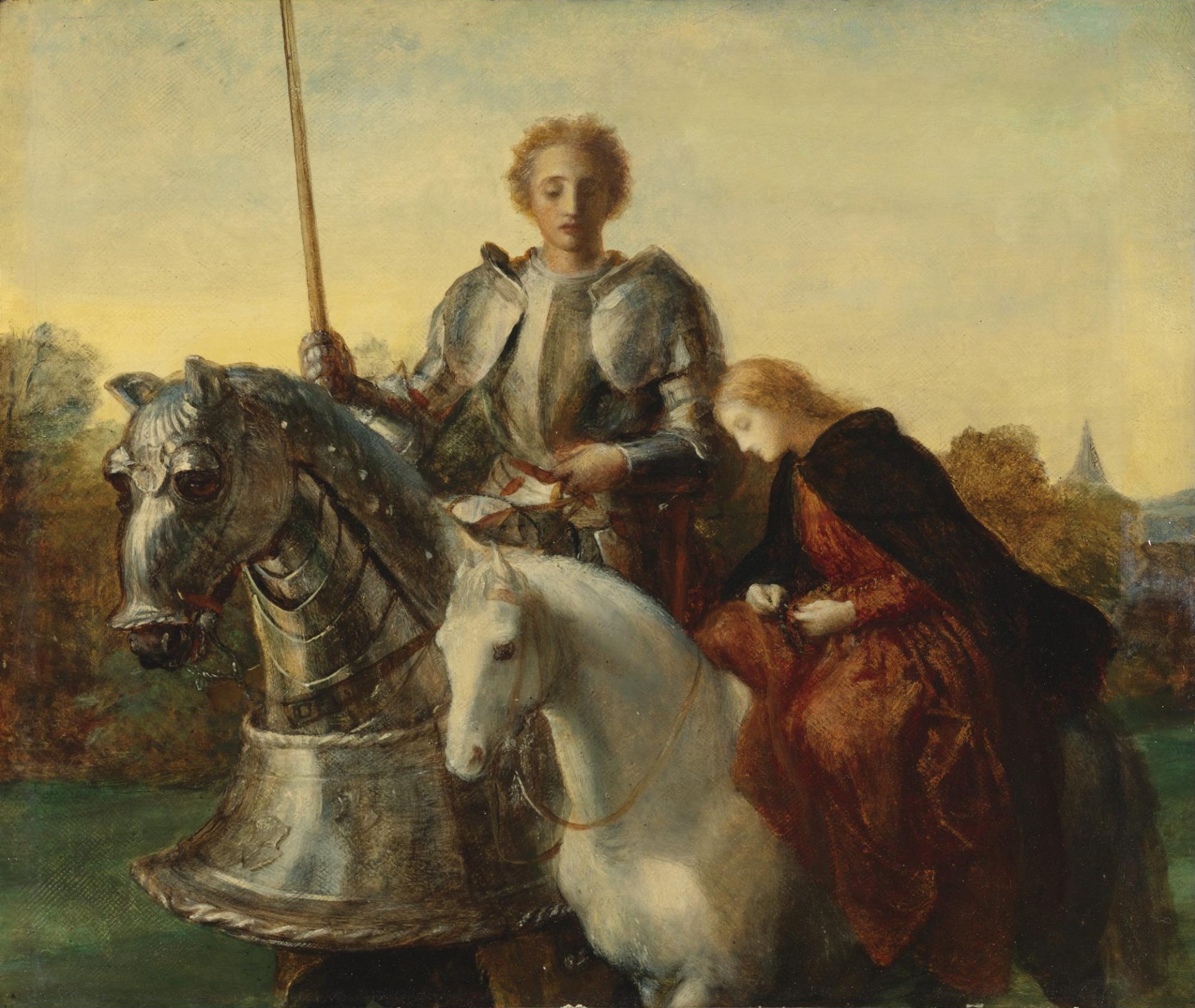
Of the works on display, George Frederic Watts’ Una and the Red Cross Knight (1860) is the most significant. The painting is an illustration of a tale from the first book of Spenser’s Faerie Queene, in which Una accompanies the Redcrosse knight on a quest to rescue her parents. The knight sits upright in the saddle, his blonde hair almost forming a halo around his head. Una, accompanying him on a donkey, represents the redemptive power of truth (and the purity of the Protestant faith, contra the witch Duessa, who stands in for Mary Queen of Scots and Catholicism). Both are painted delicately and chastely, and the curators note that they are modelled on the children of an early British investor in Western Australian colonisation. Even though the figures are realistic, Watts was a Symbolist, who used classical, Biblical and medieval scenes as an iconic grammar to illustrate his own moral ideas.
In his own time Watts was called the “English Michelangelo”. His Symbolist paintings have always had a popular appeal, like Hope (1886), his best-known. GK Chesterton admired him and wrote his biography after he passed, describing him as a “typical figure” and survival of the Victorian age. “He was born in the white and austere dawn of that great reforming century, and he has lingered after its grey and doubtful close.” Unfortunately, he was easy fodder for modernists who saw Symbolist art as sentimental, socially uncommitted, obscurantist and insufficiently autonomous—enslaved to literary themes, no better than mere illustration. He’s undergoing something of a renaissance now that modernism’s quest has exhausted itself. Una and the Red Cross Knight is in its own right worth a visit to the AGWA.
The Australian Charles Douglas Richardson’s Casting the Spell (1896), a Symbolist nude, is the other key painting on display. Richardson was sometimes called the Antipodean Watts, because of his interest in medieval and romantic themes. Like Watts, he was regarded as the equal of any of the Australian “Olympian” impressionists, like Tom Roberts and Arthur Streeton (whose works you can see in a larger exhibition from the permanent collection, on the same floor). He was also a long-standing president of the Victorian Artists’ Society. Again like Watts, he is little-remembered these days.
Casting the Spell is also a literary painting, this time from H. Rider Haggard’s She: A History of Adventure. It depicts a scene in which the witch queen Ayesha (She-Who-Must-Be-Obeyed) lays a curse on her rival:
“For a moment she stood still, her hands raised high above her head, and as she did so the white robe slipped from her down to her golden girdle, baring the blinding loveliness of her form. She stood there, her fingers clenched, and the awful look of malevolence gathered and deepened on her face […]
The arms fell and the flame sank. Up they went again, and the broad tongue of fire shot up after them; and then again they fell.
“Curse her memory—accursed be the memory of the Egyptian.”
Richardson has captured the sinister mood of the scene with a sickly, emerald luminescence, and you can see the influence of Art Nouveau on the sinuous rising smoke. The witch’s hair, which rises up with a life of its own to form a pair of monstrous wings reminds me of Edvard Munch’s The Brooch (1903). Richardson’s bold pose is thoroughly modern, without the slightest sniff of medieval chastity or Victorian moralising.
Yet what does it really symbolise? The Symbolists were wont to pimp out the female form to represent just about anything: the power of the spiritual world, or the tremors of the psyche (again, Edvard Munch), to the desirability of cigarettes and champagne (as in the ads produced by Alphonse Mucha). Australian symbolism did much the same, with everything from Australian nationalism (Loureiro’s Spirit of the Southern Cross, for instance) to hope in time of drought (Streeton’s Spirit of the Drought) taking on an XX chromosome and frolicking in this or that virginal setting. You can see an example of this across the hall in the current exhibition from the permanent collection, where two paintings are on display from Sydney Long, probably the best-known Australian Symbolist. Sydney readers can see some of his better work in the AGNSW. Anyhow—some Symbolist art was nothing but respectable pornography, like another of Richardson’s paintings, Fleur de Lys (1890), held by the NGV. The reader can decide whether Casting the Spell escapes that charge.
However, as indicated by the presence of Una (oneness) in Watts’ painting, there is also a Sophianic reverence for the woman in Symbolist art. This is most clearly expressed by the key role given to the divine feminine within the country where Symbolism reached its most sublime form, Russia. Consider those greats of the Russian “silver age”, like Vladimir Soloviev, theologian and martyr Pavel Florensky, painter Viktor Vasnetsov and the novelist Fyodor Dostoyevsky. All of them were preoccupied to some extent with the unity of all, represented by Divine Wisdom in female form; Soloviev “caught” Sophiology after a series of visions of a beautiful divine woman in Egypt. Florensky devoted part of his The Pillar and Ground of the Truth to the subject of the divine Sophia. Even Dostoyevsky; consider Sonya (Sofia) Marmeladova in Crime and Punishment. So while Richardson’s Casting a Spell is one of the high-water marks of Australian Symbolism and is worth a look for that reason, it also shows something of the Symbolists’ belief in the pre-eminent capacity of the image (especially of the female image) to speak to the non-rational faculties of the soul. As Aby Warburg famously said, “Athens wants always to be reconquered from Alexandria”; reason’s secret desire is to be put under the spell of the symbolic (and feminine), like Phyllis jockeying Aristotle.
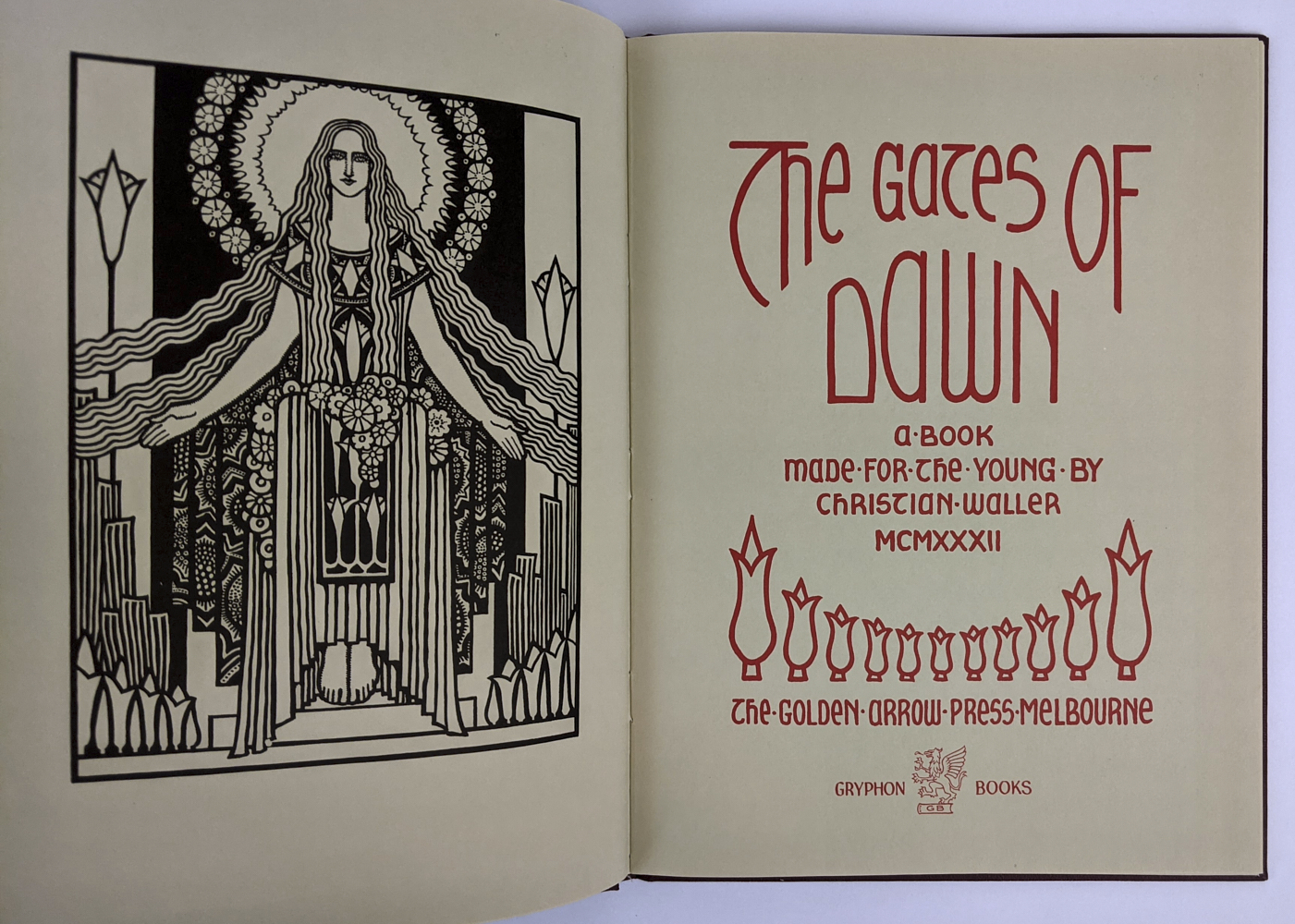
Back to the exhibition—a series of lithographs by Aubrey Beardsley, chapter illustrations from Malory’s Le morte d’Arthur (1893), show the adaptability of Symbolism to the stylistic vogues of the time. Beardsley developed an early reputation as both a dandy and a prodigious draughtsman, was friends with Oscar Wilde, and reportedly worked in a black-wallpapered room with a skeleton sitting at the piano. He was commissioned to produce the illustrations for Le Morte d’Arthur when he was barely 20. The artist perished from tuberculosis, aged 26, so they are one of his better-known works. These small illustrations show Beardsley’s debt to both the Art Nouveau and to the Aesthetic movement’s “Japonisme”—especially to Japanese block printing, textiles, furniture etc. At times his strong, bold vertical lines seem even to anticipate Art Deco. It would have been nice to have an Australian comparison to show the transmission of Beardley’s style to our own artists, many of whom were more explicitly medievalist. I’m sure the gallery has a copy of Christian Waller’s The Gates of Dawn tucked away somewhere.
Symbolism’s cousin, the Pre-Raphaelite movement, is represented in this exhibition mostly by small engravings and prints, such as Lady Lilith (1867) by the founding Pre-Raphaelite, Dante Rossetti. Pre-Raphaelitism differed from Symbolism in its genuine love for historical and natural detail. Artists like Rossetti, Edward Burne-Jones and William Morris saw the medieval age not just as a source of symbols to be adapted but as a form of life preferable to modernity. They also followed the doctrines of the Victorian artistic great John Ruskin in paying close attention to the variations of nature as a theophany of God. They tended to represent plant and animal life faithfully as a result, as can be seen in Morris’ wallpaper patterns and frontispieces. The Pre-Raphaelites also tended to ally art with craft, producing many illustrated books, tapestries, stained-glass windows and other objects; whereas the Symbolists were happy to go along, to some extent, with impressionism and other modern artistic fashions, as Richardson’s Casting a Spell makes clear. In any case, along with the small pieces from Rossetti, Beardsley and others, there is a 1896 engraving from an edition of Chaucer printed by Morris’ Kelmscott Press, to which he and Burne-Jones contributed. It’s not a major piece, but is very charming, and so few copies were ever printed that it is quite rare. That said, you can pick up similar printings of the classics, and even the Gospels, for a good price in many antique bookstores in Melbourne and online. And for an affordable $20,000 it’s still possible to get an original Kelmscott Press Life of St Thomas More from the UK.
The other pieces on display at the AGWA are well worth seeing, in particular the great war propaganda posters and John Charles Dollman’s The Ride of the Valkyrs (1908). Regrettably, the curatorial statements typically alternate between the uninteresting and the unhelpful. They range widely through sub-Foucauldian territory, musing on anxieties about the body, nationalism, and so on, and are not all that illuminating. The curator describes medievalism skeptically as a “not-now … an escape from the conditions of a developing modernity in particular”. Ironically, Chesterton said that “escape” was the last word he would use to describe Watts, whose life was held together by the thread of Victorian seriousness and motivated by “a sense of the joyful austerity of things … his ideal is altogether duty and the great wheel.” Other Symbolists—Richardson among them—were obsessed with the lush tangle of Victorian progressivism, technology, Darwinian evolution and fashionable “evolved” religiosity: spiritualism, theosophy, seances, mesmerism and so on. It was as “now” as you could get in 1896.
On the other hand, if it was true that the Pre-Raphaelites were escapists—and they probably were—they were described by William Gaunt as a tragedy, because their ideal was too impotent to achieve escape velocity. They represented a noble but doomed tendency, and still get unfairly trashed. The brotherhood, along with their hero John Ruskin, was drowned in scorn for their backwardness, leading them into neuroticism, addiction and infighting, with tragic outcomes. To name just one: Rosetti’s wife Elizabeth Siddal, who posed for Millais’ Ophelia, and many other Pre-Raphaelite paintings, most likely took her own life with a laudanum overdose after suffering a stillbirth. Ironically, the only original Pre-Raphaelite who ever truly “escaped” was the sculptor Thomas Woolner, who migrated to Australia. He made his fortune as an artist when he failed on the goldfields, then returned to England. Woolner’s statue of Captain Cook in Sydney’s Hyde Park is now defaced every Australia Day.
It’s worth labouring over all this because you get no particular insight from the exhibition as to why these artists were soul-sick with medievalism and could not bring themselves to become materialists. Were they brooding pessimists committed to a “retro-historicist fantasy”? Not merely—most shared William Blake’s view that the “dark Satanic mills” of materialism would rupture both nature and the human imagination, and they were right by any measure. Indeed, since Roman Polanski’s 1971 film adaptation of Macbeth we are drowning in a much worse “retro-historicist fantasy” of medieval misery: grey castles, drunk louts for kings, mud, mist and slaughter. In the last few years we’ve had two Game of Thrones spinoffs and a deluge of crappy medievalesque TV and video games, all fantasies just as much as anything that came from the Kelmscott presses, but fantasies of the unhappy consciousness of the enlightened modern.
Unlike George RR Martin or Andrzej Sapkowski, Morris, Rosetti, Watts and others like them had genuine affection for the medieval, or for a gracious fantasy of the medieval. One or two encounters with their art is usually enough to infect the viewer with love for their vision. A revival of Symbolism and the Pre-Raphaelite dream would do us good today because, in spite of its curation, Chivalry is Dead? reminds us that medievalist soul-sickness is a pessimism born of longing for something precious that seems to have been lost, but is truly quite close to hand.
Adam Wesselinoff is a former editor of The Catholic Weekly and was the English Speaking Union of Victoria’s 2024 writer in residence. He is writing a book about spirituality and contemporary Australian art.