
I have written before about the joys of unfairly advantaging one’s children by reading aloud to them. This nightly routine has been a source of great delight to both my children and to me. Of course, the time spent in collective imaginings is a great way to grow together, but I am increasingly grateful for the fact that it has afforded me the time to read such truly wonderful literature that would have otherwise never gotten around to, or ignorantly simply dismissed as ‘for children’ and thus not for me.
I have decided that I will occasionally make use these monthly blog posts on the Dawson Society blog, ‘Essays in no particular order’—a playful but rather obscure homage to Dawson’s own work as editor of a tremendous series which ran from 1931-1936 and was titled Essays in Order—to review some of my favourite as well as most despised reads (you might be familiar with my take on the execrable moralistic tale Pollyanna, which garnered both praise and push back from readers far and wide).
One thing that I realised when I started reading to my children was their utter fascination with the realm of the faerie. It was and remains a fascination which I share, and which has guided a great deal of our reading over the years. We’ve read through a number of Grimm’s tales, as well as Andrew Lang’s Blue Book, and other folk and faerie tales, but a favourite in this genre is the 1941 classic, The Little Grey Men by B.B.
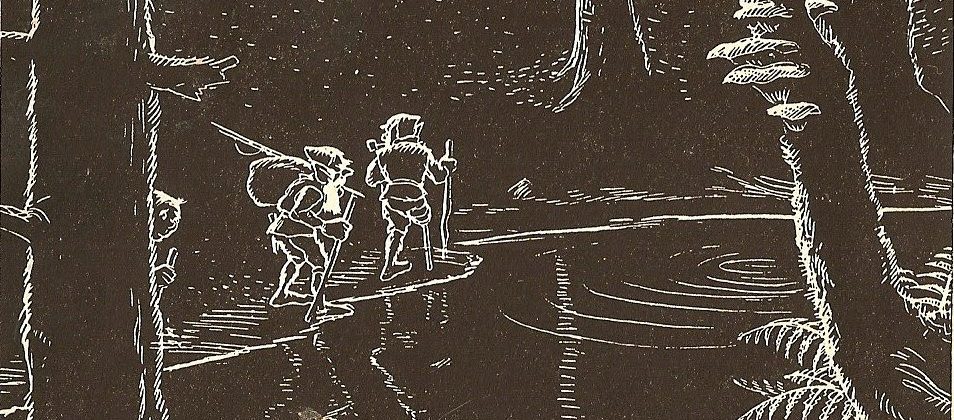
B.B., who my children insist must be the moniker of Bilbo Baggins, was in fact the pen name of Denys Watkins-Pitchford, who was a magnificent illustrator as well as an author, and something of naturalist – a fact which is clearly communicated in both his writing and his illustrations. The Little Grey Men tells the tale of the last gnomes in Britain, Dodder, Baldmoney, Sneezewort, who embark on a perilous journey up the Folly river to the ‘source’ in search of their long-lost brother Cloudberry.
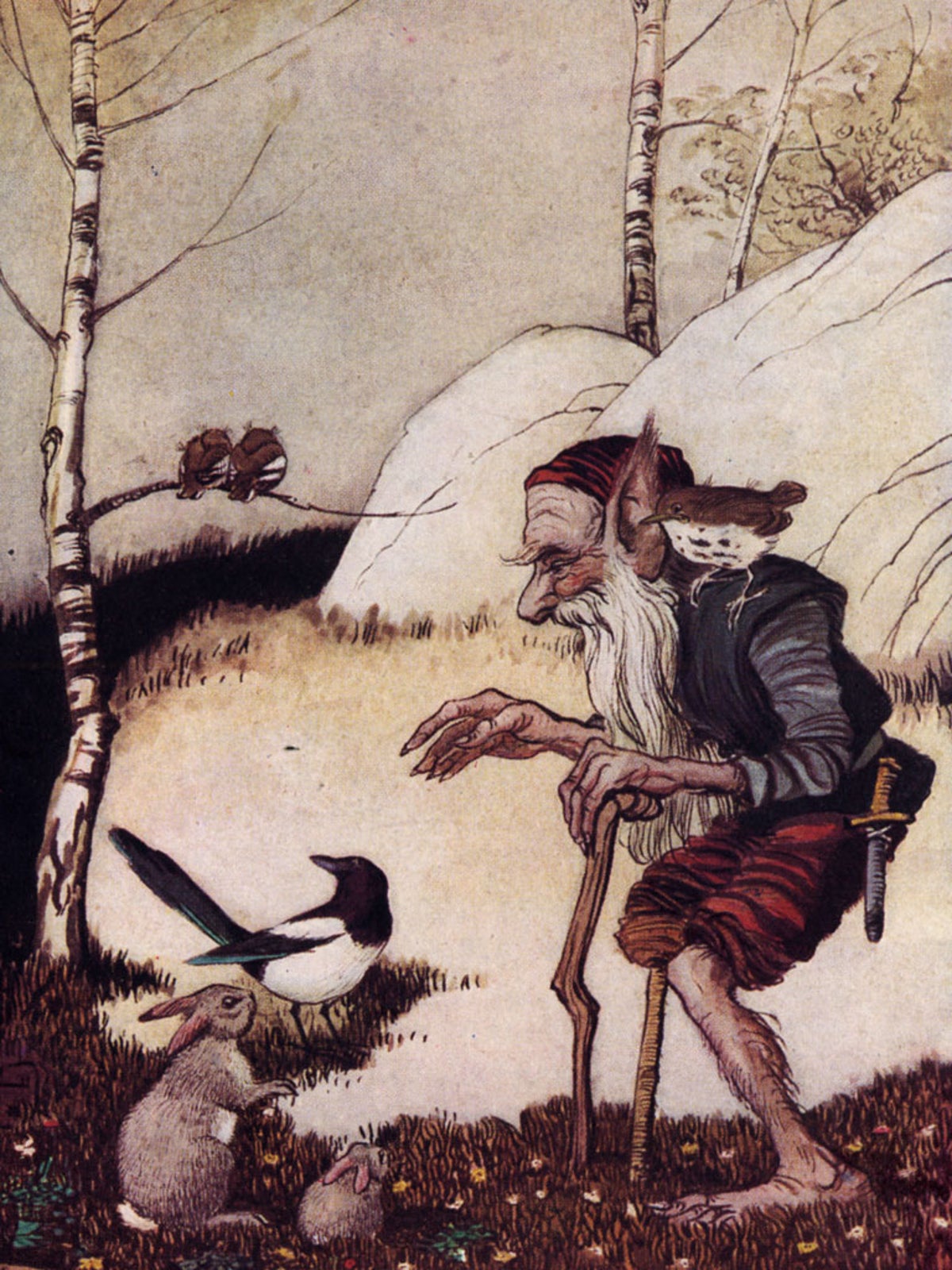
As we read in the author’s introduction:
This is a story about the last gnomes in Britain. They are honest-to-goodness gnomes, none of your baby, fairy-book tinsel stuff, and they live by hunting and fishing, like the animals and birds, which is only proper and right.
This story concerns their exploration of the Folly brook, on whose banks they dwell, and of their search for Cloudberry, their long-lost brother, who years ago went up the Folly and never returned.
It is a rollicking tale, full of action and adventure, as well as charming descriptions of English countryside with all its flora and fauna, and each chapter ending at a point which leaves the children begging for more, as they eagerly guess at what might come next.
What I have found so fascinating about the faerie books we have read is that they do a tremendous job of opening up the imagination to aspects of reality that have been bleached away in the modern technological era, tackling, sometimes head on, the scepticism and indifferentism of much that passes for modern reason. B.B. addresses this head on in his introduction:
You may not believe in the Little People, but that is because most fairy books portray miniature men and women with ridiculous tinsel wings, doing all sorts of impossible things with flowers and cobwebs. That sort of make-believe is all right for some people, but it won’t do for you and me.
If you don’t believe in the Little People, I would ask you to make yourself as small as possible (which is horribly difficult) and keep very quiet (which is more difficult still) and watch and wait by the streams and in the woods, as I have done. And suddenly you will understand that the birds and wild animals are the Little People! Such a simple fact, and yet we never realized it!
While there certainly is something a little romantic about this view, I am of the firm opinion that there is of course something true in it also. Such a view of the ‘wild’ is easily dismissed by our modern scientific and technological mindset as cutesy or kitsch, but it seems to me that this vision of reality is likely much closer to what is in fact true than the materialistic and purely immanentist ambience of our modern scientific and technological society. Of course, we do not really need to believe that there is a gnome or a fairy pushing up each blade of grass, but the tales of the faerie convey a vision of reality that is constitutively far more open to a broader conception of reality than the scientistic, mechanistic, and empiricist vision of things that simply passes for common sense in today’s world. It is precisely this fact that makes the realm of the faerie one that is truly worthy of exploration and attention.
 It is true that Christianity certainly does the work of a particular demythologising of the pagan world, but a genuinely Christian demythologising does not leave us with the beige walls, stainless steel bench-tops, and fluorescent lights of a sterile science lab. It rather sifts the myths that led the ancient pagans to fear particular elements of the natural world, and it effectively stifled any reasoned inquiry into it, and instead redirects our vision, retaining and clarifying whatever contained within them that is true, and good, and beautiful. We might not believe that the grass grows because a gnome is pushing it up, but perhaps we should entertain the fact that an angel is effectively actualising all the ‘natural’ potencies of the grass and coaxing it up, inviting that blade of grass to grow into its fullness and in so doing give glory to God.
Tales such as B.B.’s The Little Grey Men give us permission to consider reality as considerably more expansive than is otherwise allowed, and that is a vision that I am eager to cultivate, not just in my children, but in myself. You can nab yourself a tidy paperback copy of this tale published by Oxford University Press (2012) complete with Watkins-Pitchford’s delightful illustrations, but if you’re lucky, you’ll find a nicer clothbound one in a second-hand bookstore. It is one that both my children and I would heartily recommend.

