The artichoke is a tractable bloke
wherever he strikes his root.
Where summers scorch, and water is short
he waits for autumn to shoot.
In colder climes, he bides his time
till springtide warms his bower.
From dormant state, he bolts awake:
silver leaf and purple flower.
— D. M.
When I was growing up, artichokes came in glass jars.
They were the sort of food that arrived in a third-placed Christmas raffle hamper or in the donated box of a (well-meaning) stranger who assumed that my family’s large size must correlate with Dickensian scarcity at its kitchen table.[i]
Their culinary use, I am sorry to report, was entirely without conviction. They might find themselves snuck onto the edge of cheese platters or tentatively stirred through a pot of pasta when a meal was required on short notice. More frequently the jars became semi-permanent tenants of the kitchen alongside such fellow-travellers as a can missing its label and a half-used mystery spice rub.
No one particularly disliked artichokes. But no one knew what to do with them either. Between ages one and twenty-five I would be surprised if I ate my way into double figures.
But all this changed when I planted my first serious vegetable garden some eight years ago. My gardening philosophy can be stated quite simply – grow what grows well. In search of what grows well in my particular patch, I have grown (and I have killed) a lot of different plants.
And artichokes grow well.
Actually, artichokes grow magnificently.
The first of their leaves, silver against the brown debris of last year’s stalks, emerge after thunderstorms in the autumn. For weeks it seems that they hardly grow at all. Then, once winter rains have saturated the soil, they surge.
Their many-pointed foliage is like something taken from the margin of an illuminated manuscript. From above they appear more like sculptures than living things. Their leaves cascade out and up forming a starry symmetry around the centre of the plant. When leaf is joined by stem and head, they hold that same poise and majesty as their heraldic cousin, the thistle.
But stick your head beneath the foliage and you will experience a different world. A humid jungle of frond and leaf tip, of the rotting garden floor and the silver trapeze above. This is my favourite place to spy the acrobatics of slender tree frogs in the stems or the western spotted frog sheltering beneath broken leaves.
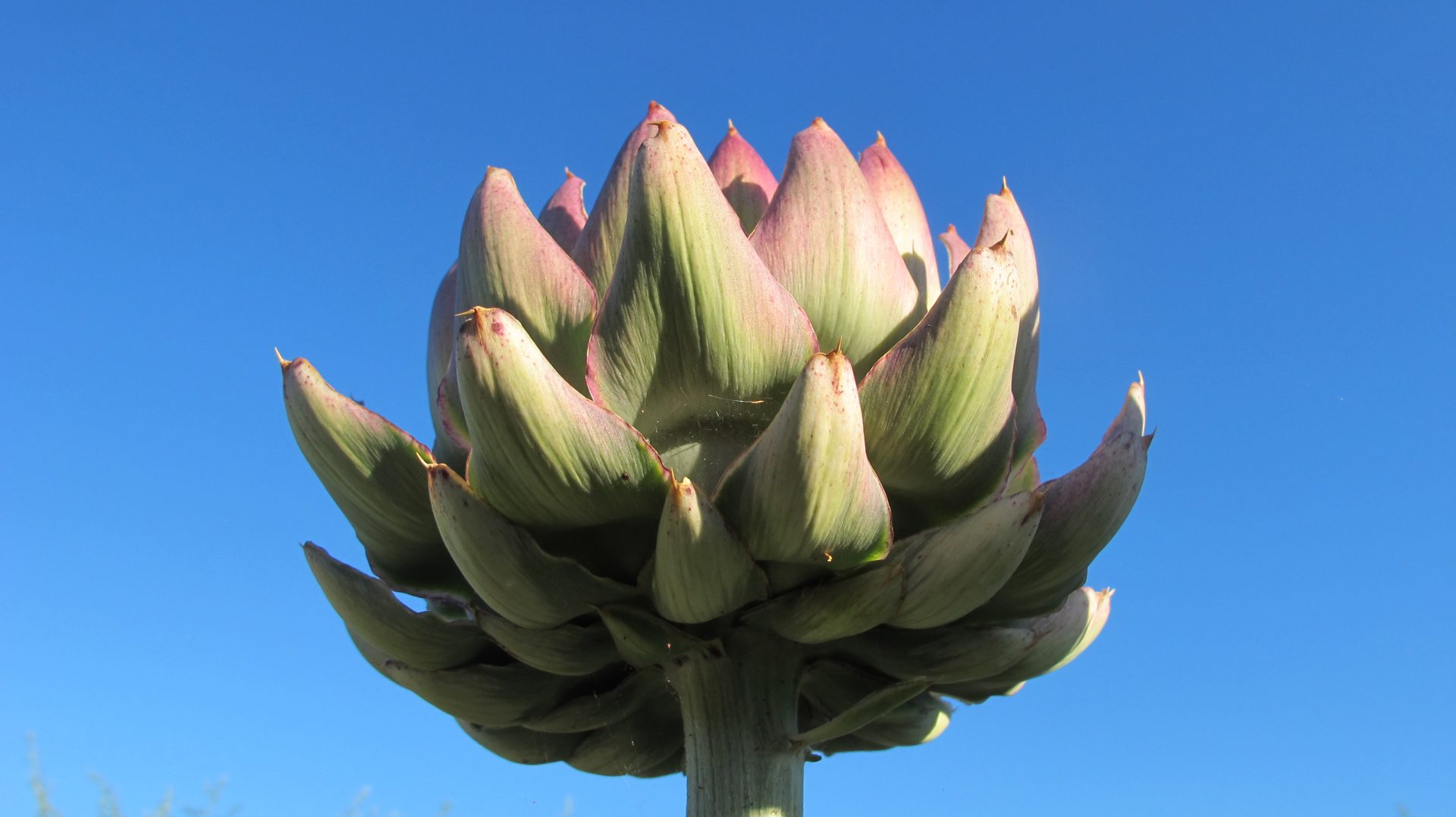
The flower heads emerge in spring. These scaly protrusions are shaped like dragon eggs and can grow to the size of a toddler’s head in various shades of purple and green.
The stems can tower up to two metres high, a ridiculous transformation from the tiny shoots just a few months before. As the weather warms, the flowers open and with them a new drama.
Hundreds of florets like violet pins in a pin cushion point upwards signalling to bees and other pollinators. These arrive in prodigious numbers, more than on any other flower I grow. A spiralling knot of insects twisting above the flowers until the sun sets.
In Leaves of Grass, Walt Whitman asks, “who makes much of a miracle?” It is a provocative question for a disenchanted world. Whitman’s answer is not to disparage or deny but to expand.
Whitman’s list of miracles (there are many) includes “[wading] with naked feet along the beach just in the edge of the water” or looking upon the “animals feeding in the fields” or upon “strangers opposite me riding in the car”. His is a world that swarms with miracles: the “whole referring, yet each distinct and in its place.”
The artichoke is an invitation into Whitman’s world of miracles. Its explosive vivacity – transforming its patch from last year’s dead debris to this year’s heaving mass of silver leaves and spiring flowers and back again – is miraculous. If we can see it.
And the miraculous extends from the garden to the kitchen. God bless that first cook who discovered that the immature heads of this tough, fibrous flower are (with appropriate trimming) perfectly and deliciously edible.
I have no quarrel with the jarred artichokes of my childhood. I marinate a jar myself from time to time. But my favourite way to eat an artichoke is fresh. Braised Roman-style in olive oil, lemon, and white wine. It retains all the delightful texture of its marinated relative but without any mellowing of its flavour. It is nutty and earthy. There is a hint of aniseed deep within its heart.
And if the wonders were not enough, there is its ‘sweet’ effect. A temporary transformation of your taste buds which makes anything eaten or drunk immediately afterwards seem sweet.
It leaves me (after eight hundred words at any rate) speechless.
Benedictus Dominus.
[i] In the mode of the Cratchits or Oliver Twist. And with absolutely no culinary input from Miss Havisham.