I have been thinking a bit about the concept of sabbath these past few weeks, having recently read Rabbi Abraham Heschell’s beautiful (and beautifully brief) book on the topic. My piecemeal thinking about this subject was evident in my blog post from last month as I tried to think through something of the effect of the loss, not just of the concept of sabbath, but the loss of its practice in Australian culture.
It has become clear to me that the command to observe the sabbath (the third or fourth of the ten commandments, depending on how you count them), the command to truly rest and recreate and to devote oneself to the worship of God is, rather oddly in my opinion, not a command that is easily observable. The command to be still and to simply receive what is given to me in God’s providential goodness is more difficult to observe than my propensity to laziness would have had me believe. Why is this so?
Upon reflection, I have come to see the command to keep the sabbath both as a gift and as a task, and in that sense it becomes a kind of fractal image or microcosm of reality as a whole. Allow me to explain.
For months now I have been dipping in and out of a great philosophical tome Homo Abyssus by the German metaphysician Ferdinand Ulrich (1931-2020), recently translated by D. C. Schindler (2018, Humanum Academic Press). It is, for me at least, a difficult book—the kind of book that one has to read a single page at a time, and which forces one to lie down after having struggled through each page. While it is certainly a difficult chew, I have been able to glean some meaning from its pages with the help both of Schindler’s lexicon appended to his translation, and some secondary literature that is now coming to the fore, not least of which is Schindler’s Companion to the work, as well as helpful texts by Bishop Stefan Oster SDB, and Drs Rachel Coleman, and Michael Domenic Taylor. This reading exercise has been fruitful for me.
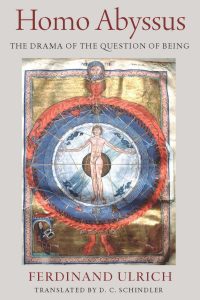 Within the book Ulrich offers a way to understand or better, approach, being itself. Being, as he argues, is best understood as a gift, given by God. But it is not only given as a gift, but it is given to be realised, that is, given as a task. Ulrich is doing some interesting word play in his native German language by employing a hyphen in the term Auf-Gabe (gabe: gift; Aufgabe: task).[1]
The Sabbath, as I have come to understand it, both in my reading of the Old Testament Scriptures and the writings of Heschel and John Paul II, can be understood as something of a microcosm of being itself, that is as both a gift and as a task. It is given as an opportunity to really exercise faith in the providence of God, calling forth our freedom in a most unexpected way. The classic example of this law in action is found in the book of Exodus where we read what the Israelites are to do on the sabbath as they wander through the desert [13:22-30]. It is an interesting incident, and one which I can’t help but find myself in.
It is worth remembering the context. The Israelites, having been miraculously led out of Egypt are now wandering the desert. There is no food there, and yet every day God provides for their needs. As they wake each morning, there is food all about: manna or bread from heaven, and all they need to do is to go out to gather it. Later in the evening, again, their needs are provided for as flocks of quails descend on their camp, and all they need to do is to go out to gather what God has sent so that they can eat.
God provides this for the people each day and instructs them that they are not to hold any over to the next day. They are to have faith that he will continue to provide, to trust him, and to rely on his providence. We should remember here that it is no blind faith that he is calling them to, it is wholly reasonable: The Israelites have a truckload of evidence that God can and will provide, they’ve witnessed his miraculous deliverance of them from slavery in Egypt, and they see it constantly in his daily provision where God is faithful in providing this sustenance for them day in, day out. This is the context within which the command to observe the sabbath is given.
As the sabbath approaches the people are given instruction to gather twice as much as they need for one day, and to hold the leftovers for the next day, the sabbath day, the day where they are to do no work: ‘So they laid it by till the morning, as Moses bade them; and it did not become foul, and there were no worms in it.’ It all sounds pretty good. Immediately however we are told that many doubted, that is they could not trust in God’s providence, and so they went out to gather on the sabbath (see Ex 16:27).
In their doubt, those who go out to gather on that sabbath demonstrate a fundamental misunderstanding, not only of God and his providence, but also of the nature of created reality. Failing to see reality for what it is, that is a gift and a task, they fall into the error of seeing reality as merely a task, as something that I must trudge through or simply create by exertion of my own forceful will; or as merely a given, something that simply happens to me, thrown into reality as I seemingly am. Perhaps this is why modern men and women such as ourselves tend to be afflicted both with hyperactivity on the one hand, and laziness on the other (what Matthew John Paul Tan, following R.J. Snell, termed ‘acedia’ at a Dawson Society Speakers Forum event in 2019, you can listen to that recording here)
Sabbath rest however is not something achieved by sheer force of will, but at the same time, it really does require something of me. Paradoxically, sabbath rest is something that I must receive actively. The command to be unproductive requires real deliberate effort, it is an effort to remember and to remember with gratitude: “remember that you were a slave in the land of Egypt” (Deut. 5:15). This effort should serve as a reminder that we are not the cause of our own existence and hopefully habituate us to a way of living that is congruent with the shape of created reality.
[1] See the entry for this term in D.C. Schindler’s lexicon, Ferdinand Ulrich, Homo Abyssus: The Drama of the Question of Being (Humanum Academic Press, 2018), 498.