The poetry of Robert Frost hardly needs introduction.
His most famous poems, the likes of “The Road Not Taken”, “Stopping by Woods on a Snowy Evening”, “Fire and Ice” or “Nothing Gold Can Stay” have become part of the cultural lexicon even in a land so remote as the south-west of Australia where the imagery of rural New England, with its green shoots in spring and its snowy winter evenings, cannot be easily transposed upon the native landscape.
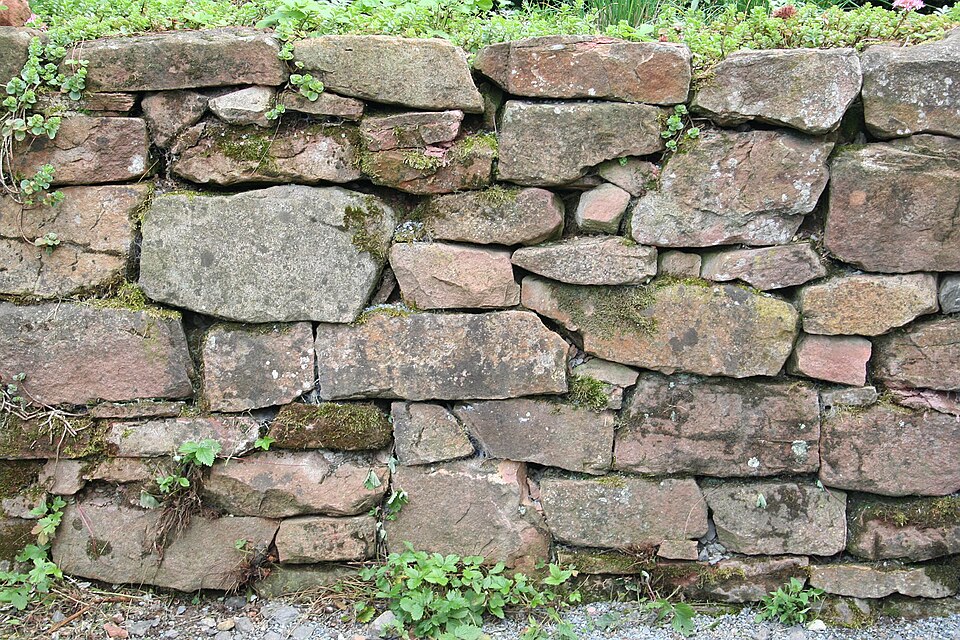
Among the most well-known of Frost’s poems, is “Mending Wall” a poem structure around the yearly task of repairing a stone boundary wall shared by neighbouring farmers.
Mending Wall (1914)
Something there is that doesn’t love a wall,
That sends the frozen-ground-swell under it,
And spills the upper boulders in the sun;
And makes gaps even two can pass abreast.
The work of hunters is another thing:
I have come after them and made repair
Where they have left not one stone on a stone,
But they would have the rabbit out of hiding,
To please the yelping dogs. The gaps I mean,
No one has seen them made or heard them made,
But at spring mending-time we find them there.
I let my neighbor know beyond the hill;
And on a day we meet to walk the line
And set the wall between us once again.
We keep the wall between us as we go.
To each the boulders that have fallen to each.
And some are loaves and some so nearly balls
We have to use a spell to make them balance:
‘Stay where you are until our backs are turned!’
We wear our fingers rough with handling them.
Oh, just another kind of out-door game,
One on a side. It comes to little more:
There where it is we do not need the wall:
He is all pine and I am apple orchard.
My apple trees will never get across
And eat the cones under his pines, I tell him.
He only says, ‘Good fences make good neighbors.’
Spring is the mischief in me, and I wonder
If I could put a notion in his head:
‘Why do they make good neighbors? Isn’t it
Where there are cows? But here there are no cows.
Before I built a wall I’d ask to know
What I was walling in or walling out,
And to whom I was like to give offense.
Something there is that doesn’t love a wall,
That wants it down.’ I could say ‘Elves’ to him,
But it’s not elves exactly, and I’d rather
He said it for himself. I see him there
Bringing a stone grasped firmly by the top
In each hand, like an old-stone savage armed.
He moves in darkness as it seems to me,
Not of woods only and the shade of trees.
He will not go behind his father’s saying,
And he likes having thought of it so well
He says again, ‘Good fences make good neighbors.’
As is the case for much of Frost’s poetry, the simple (if not downright nostalgic) rural imagery just barely veils a darker, pessimistic, assessment of human nature and its place upon the planet.
This pessimism is manifested from the opening line, “Something there is that doesn’t love a wall”, which is repeated in the poem. The line is obviously suggestive of something more than the literal observation that walls, indeed all human constructs, require maintenance.
‘Elves’ is the name given to this ‘something’, this unmaking force, though the narrator admits that elves does not exactly fit. The species of these elves seems to my mind to be neither the diminutive creatures of the Victorian imagination nor the noble elder race of Tolkien’s legendarium. These must be something older, more ‘other’, more alien. These elves are the fae, the kind that appear in the medieval mind, in the lines of lays like Sir Orfeo whose interactions with the human world are sporadic, sometimes harmful, and always without regard to the desires of those humans who within their power.
Yet the ominous, if vague, suggestion a “something” that operates without regard of human boundaries or purpose in the poem, is not the only pessimistic note within ‘Mending Wall’. Within many of Frost’s poems runs a deep cynicism concerning human nature itself. It is present in the poem ‘Fire and Ice’ where the poet casually attributes the (future) end of the world to unavoidable extremes of human nature, the titular ‘fire’ or human desire, and ‘ice’ or human hatred. And this cynicism is also evidence in ‘Mending Wall’ in the image of the poet’s neighbour “like an old-stone savage armed” moving “in darkness”.
The cliche, that “good fences make good neighbours” is not in itself objectionable. Rather it is the superstitious faith placed in phrase by the neighbour who cannot be brought to consider the purpose or necessity of his task. The image of this, presumably modern and educated New England farmer as a ‘savage’ moving in darkness forms a poetic rebuke to the project of reason and human perfectibility begun first spiritually and intellectually in the Enlightenment and later corporealized in the advancements of the Industrial Revolution. Human nature, according to Frost at least, might be as alien and ‘other’ as the elvish ‘something’ that unmakes our creations.
This pessimism of Frost arrives at a specific moment in history. In 1914 the almost religious belief in Western nations in progress, in reason, and in civilisation was shaken – if not temporarily destroyed – by the bloodletting of the Great War. As two hundred years of progress in science and industry was turn towards the decidedly nonprogressive ends of slaughtering the youth of Europe on battlefields across the continent, it seemed for a moment that the belief in ‘progress’, which had animated Western civilisation since the Enlightenment was faltering.
Christopher Dawson himself writes of this moment in one of his most insightful and important works, Progress and Religion (1928). After tracing how belief in progress replaced belief in Christianity for many of Europe’s elites in the 18th and 19th centuries, Dawson writes of his own time than “Today, the belief in progress is no longer an unquestioned dogma; it has become a problem. The old optimistic faith in the steady and inevitable advance of humanity has been shaken, if not destroyed.”
Where Dawson saw this demise in the faith of human progress as an opportunity, Frost’s poetry is far more ambivalent about what the forces of an alien nature (including human nature) might mean for human society. Yet both, I believe, would have been surprised the return of an optimistic belief in progress that marked the second half of the twentieth century.
In the aftermath of World War One, progress may have been temporarily dethroned as the animating belief of modernity, but it was not destroyed.
Yet, in the beginning of the 21st century, as approach a hundred years since the publication of Progress and Religion, it seems that faith in progress might not be as steady as it once was. And, as our society becomes a little more divided and a little less rational, it seems to me that we, like Frost, might too see the “old-stone savage … moving in darkness” across the boundary fence.