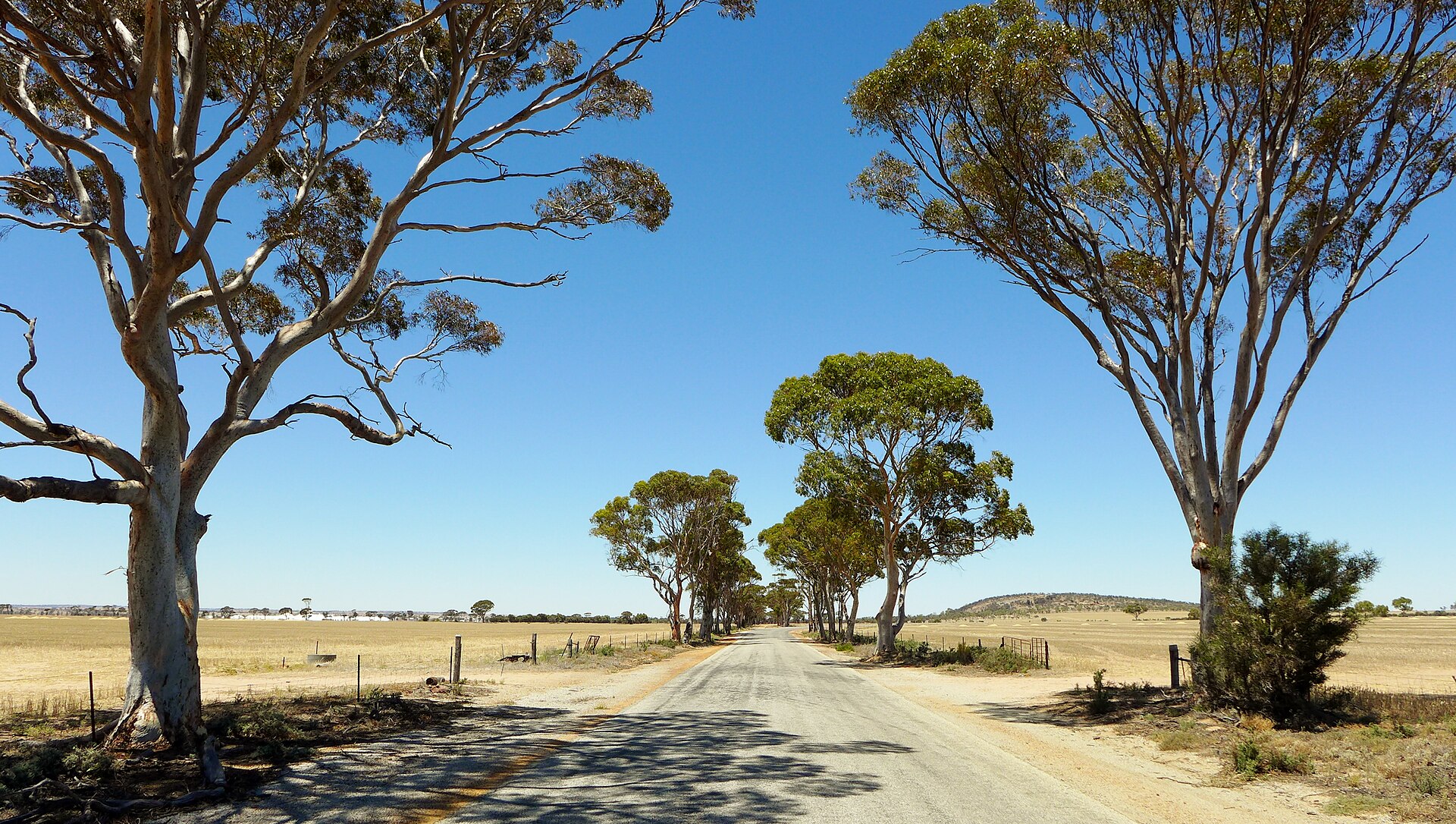
I love the landscape of the Wheatbelt.
Which is a good thing given the hours I spend driving through it. This latest appreciation (and the inspiration of this essay) was provoked by some ten hours spent traversing the Wheatbelt (with no less than three kids and a new puppy in tow), mostly south to north but with a decent enough westerly swing for the setting sun to blind me on and off for the last 90 minutes of the drive.
It is, as I say, a good thing that I love the Wheatbelt.
This particular journey was begun in Margaret River following an annual camping trip with my sons. Its purpose was to pickup our new kelpie puppy from its stud in Lake Grace before returning home to Toodyay. In doing so, Google Maps promised me about three and a half hours less driving[i] than if the camping trip and dog pick up were conducted separately.
I am not sure that the owner of the kelpie stud fully appreciated this logic. The idea that a customer in Toodyay would travel via Margaret River to save driving time seemed to him to be the sort of logic reserved for the chronically stupid or the clinically insane. Or at least I inferred as much from the expressive silence that met my explanation when I scheduled the dog’s pickup. And I’ll admit that, by the third toilet stop of the trip, I was not so sure that he was entirely mistaken.[ii]
So, all in all, there was a great deal of time for reflection on this particular journey. And the changing landscape itself inspired reflection as we left the forests and hills of the South West for the plains and salt lakes of the Wheatbelt.
It occurred to me as I drove that I was covering more than a literal distance. Symbolically, Margaret River and Lake Grace seemed to stand as opposites within the Australian landscape that harbours them both.
There are, of course, the obvious differences of flora. The forests of the South West were, in places, a kaleidoscope of wildflower colours. Tall jarrah, marri, and karri forests form tunnels around the edges of the road hosting vibrant blues, pinks, oranges, purples and golds. In places the pasture grasses reached the bellies of the cattle that grazed upon them. A pastoral paradise with an Australian twist.
The Wheatbelt hosts its own trees and flowers, but these are in a much different league. The predominant theme is yellow, with canola, capeweed, and acacia all contributing to this motif, though the discerning eye can pick the oranges, blues and purples along the edges of roads. The grass does not withstand much comparison and the trees, where clearing has not stripped the landscape entirely, might be considered a forest in the most technical sense.
Geographically too, the South West seems more interesting. Just a short walk from our campsite high limestone cliffs dramatically signal the coastline and some of the best surfing in Western Australia. Winding rivers cut their path between green hills. Caves treat visitors to magnificent stalactites and stalagmites reflected in the dark waters of underground lakes.
The Wheatbelt cannot boast of any of these features. Some years ago I was driving a visitor from Spain through the Wheatbelt plains. I still remember the unfolding look of horror on his face when I explained that the plains we were driving through continued pretty well unbroken for a thousand kilometres to the north and east and some 500 kilometres to the south.
But the difference between the South West and the Wheatbelt is more than a feature of geography or vegetation. This too was apparent to me when I stopped in the bustling main street of Nannup and ordered a coffee with a wait time of 20 minutes. There were at least three cafes, two woodworking shops, and a gallery all within a 50-metre radius and all bustling with people. Hours later when I stopped in a Wheatbelt town, whose name I cannot now remember, there was no wait and the bakery at which I ordered was surrounded mostly by empty storefronts.
The South West is the object of a journey; a place that people wish to visit. The Wheatbelt is travelled over or travelled through; a place from which its own inhabitants seem in need of regular respite.
The reality that some places on Earth are more distinctive, more favourable to human habitation, and more desirable to visit is a truth upon which the multi-trillion-dollar tourism industry is built. And, at the right time and in the right place, there is nothing wrong with a tourist.
But tourism and travel are not automatically good for the soul, no matter how many vested interests try to convince you that travel expands your mind or horizons. Lurking within the mindset of a tourist is the potential for a spiritual trap, a sort of desecrating vision that overwhelms the sanctity of ordinary tastes and pleasures with the spice of the novel and exotic.
I hold as religious truth that beauty is found in all places. But our vision often needs tuning and retuning particularly when, as the saying goes, familiarity breeds contempt.
The trees of the South West are undeniably magnificent. But I would rob myself of much joy if I allowed comparison to blind my appreciation of the rugged adaptability of the York Gum, the dappled delight of the trunk of a Wandoo, or the splendour of the setting sunlight upon a Salmon Gum.
To take the argument one step further, the problem of the tourist is that they cannot really love the places that they visit. Or, as the definition of ‘love’ in the English language is admittedly broad, they cannot love these places in the truest sense. Cannot love them in the sense that a parent loves their children even while they are fully alive to their flaws and shortcomings. It is only when we appreciate a thing for itself, without comparison, that this sort of love becomes possible.
Tourists don’t vote in local elections. They don’t start petitions or progress associations, run businesses and community gardens or sit on school boards. They admire. They enjoy. And then they leave. And if there is nothing exceptional to be admired or enjoyed, then they do not visit at all.
Having recently played the part of tourist to some success myself, I have no wish to quarrel with the role. But the mindset that characterises a tourist cannot be allowed to survive beyond the end of the vacation. If it does, and it becomes the mode through which we engage the landscapes and communities of our homes, then we risk becoming thieves. Thieves not only of the love of our own place but also of the attention and commitment to our own locality that could build precisely the sort of place people might wish to visit.
The Bible commands us to love our neighbour. This is easier when we love the acres upon which the neighbourhood is built.
As I drove into Lake Grace my mind’s eye was fresh with the vibrant flowers of Margaret River. Yet, as we passed the enormous salt lakes after which the town is named, peeking between the low saline shrubs were little pockets of a vibrant pink flower. It may, in strict comparison, lack some of the hues and tones of what I had witnessed earlier that day but those pink patches between the white saline sand and purple water of the lake were, of themselves, well worth the journey.
[i] A not insignificant reduction when diesel prices are topping $3 a litre.
[ii] And this was more or less confirmed when, to combat the boredom in the back seat I deployed the big guns (a preloaded audiobook of The Tales of Beatrix Potter) only to discover that this particular version came with an unskippable scholarly introduction to the text.